Author: Craig Woolard

  • Fireside chat: beyond ChatGPT for documents | Automation Hero

    Companies are increasing their investments in AI due to the influence of ChatGPT. In this Fireside Chat, three industry experts led an in-depth discussion on the potential impact of AI on how we work and operate enterprises.

    The panelists discussed the need to process unstructured data using enterprise-ready AI models, such as intelligent document processing (IDP), vs. popular generative AI tools known to compromise data security.

    Jun 21, 2023 by Craig Woolard

    The image shows, from left to right, Automation Hero's founder, Stefan Groschupf, VP of Global Sales, Mark Stripp, and Chief Product Officer, Maximilian Michel who led an in-depth discussion on the accuracy, truthfulness, and security of popular LLM chatbots and more.

    If you are exploring enterprise-ready automation technologies for unstructured data, you will find this fireside chat a must-watch. The three participants from Automation Hero were:

    You can read the full bios of the speakers at the end of the article, but in the meantime, here’s a quick summary recapping the discussion between these three industry veterans:

    • Automation Hero CEO Stefan Groschupf emphasized the increasing importance and availability of AI tools for businesses. The panelists discussed the widespread global use of artificial intelligence and highlighted recent advancements in AI models like Generative Pre-trained Transformers (commonly known as GPT). 
    • They also explored the applications of AI in document processing and decision-making, highlighting the value of technology that can read and process documents with above-human accuracy, including the ability to “unlock” the business intelligence stuck in contracts, historical data, and more to improve business performance. 
    • Concerns are raised about truthfulness and security with popular pre-trained large language models (LLMs), such as ChatGPT. The panelists stressed the need for organizations to adopt enterprise-ready AI tools quickly to stay competitive.

    Watch the full recording below for more details.

    Below, we captured the best questions that stood out and highlighted the key insights from the webinar:

    Keep in touch

    What are the potential economic impacts of AI?

    Now that we can overcome nearly all of the obstacles that plagued the Big Data era through the revolutions in transformer technology, the time for large language models has arrived. According to Mark Stripp, ChatGPT, the fastest-growing app of all time, and Nvidia’s emergence as a trillion-dollar company are signs that AI is having its iPhone moment.  

    “ChatGPT, the fastest-growing app of all time, and Nvidia’s emergence as a trillion-dollar company are signs that AI is having its iPhone moment.” 

    Automation Hero CEO Stefan Groschupf set the scene by weighing in on AI’s potential business impacts over the next 20 years. According to a well known University of Oxford study, AI could eliminate 47% of US jobs over the next 20 years.

    “47% of US jobs could be eliminated by AI over the next 20 years.”

    On this, Stefan elaborated further, noting the potential impact AI will have on an organization’s ability to remain competitive in the future:

    “I do really think that we are in an incredible time right now, and the landscape in how we do business will be disrupted within the next few years. I think that very, very quickly, the world will be divided by those that are using AI tools and those who don’t.”

    Stefan highlighted the potential opportunities AI can bring to the table. According to the same Oxford University study: 

    “77% of global companies are either using or exploring AI in their businesses, and this is only going to accelerate.”

    Stefan also called attention to the wide adoption of AI tools since ChatGPT’s 2022 introduction, noting that more business leaders are increasingly recognizing the importance of AI as a business strategy:

    “45% of executives reported that the publicity of ChatGPT has prompted them to increase AI investments.”

    Every time a new disruptive technology emerges, there are those who thrive and those who are disrupted. On this topic, Stefan reminded viewers of what happened when electricity eventually replaced the steam engine. By 1920, electricity had already replaced steam as the major source of automotive power, and in 1929, electric motors represented almost 78% of the total capacity for automotive machinery. Stefan emphasized the importance for business leaders to act by incorporating enterprise-ready AI technology now or be left behind:

    “I really think that we really need to rethink how we run companies. The intelligent  enterprise is a thing that needs to be achieved very quickly because, right now, AI is a competitive advantage, but very quickly, AI will be a competitive disadvantage to those who do not adopt it early enough…If you don’t have your AI story, your AI platform, and your AI use case together, you will be disrupted.

    What is the business value of technology that reads documents?

    The panelists emphasized the value of technology that can read and process documents. When addressing this question, Stefan cited research conducted by the IDC, raising an interesting data point about the intelligence trapped inside business documents: 

    “By 2025, worldwide data will exceed 175 zettabytes. With most of this information locked inside emails, texts, PDFs, and scanned documents, it poses a real barrier to automation and digital transformation.”  

    IDC, “Intelligent Document Processing Demonstrates How AI Can Make a Practical Difference to Business Right Now”

    The panel also discussed how the ability to “unlock” the hidden value in contracts and historical data can improve executive decision-making and business performance. However, without the help of enterprise-ready AI, the data we need to process is growing rapidly, causing significant challenges for organizations worldwide: 

    “The data we need to process is only getting bigger…the problem really here…is that 80 percent of your enterprise data is unstructured, and that is the massive treasure chest.”

    Enterprise-ready AI that understands documents at the semantic level is needed to automate critical document-centric processes. Stefan explained how enterprise-ready intelligent document processing (IDP) technology helps organizations realize the full potential of their data:

    “If you think about all your business intelligence [assets]…your ERP investments, your ETL data integration data, and your warehouse investments…all of that is only scratching the surface. You didn’t even get to the core yet because that’s only 20 percent structured data. So the big question is, really, how can you quickly turn these [unstructured data] assets that you have into structured data, but then what kind of business use cases are unlocked around that?”

    What exactly is generative AI?

    Automation Hero’s Chief Product Officer, Max Michel, gave a high-level definition of generative AI. 

    “Generative AI is basically the technology behind the tools that everybody is talking about right now, so the Midjourneys and the ChatGPTs that everybody wants to use. It takes an input, for instance, a text or a prompt…and then it generates the output, so it generates a new image…or an explanation, or a poem, or whatever you ask it to do. The special thing is…it can also do things in different styles, so you can ask it for a portrait to be very photorealistic or very abstract, and that’s basically up to the user…but there’s always an input, and then an output is generated based on what the AI has learned before.

    Max also explained how generative AI tools, which generate outputs based on inputs, contrast with discriminative AI, which provides specific answers based on given parameters:

    “There’s also this other way to work with AI, and this would be the discriminative AI approach. With discriminative AI, you basically give some guidelines, so it can only group these few specific classifications, or it can only give you the answer based on the input that you gave it…this is really what you want to do in an enterprise setting…so discriminative AI is safer, but where I see the real power of generative AI is in creative work, of course.”

    What is a large language model? 

    Max explained that language models are a way to make languages computable for machines to understand. On the topic of human and computer interactions, he says:

    “In general, technology is really good at stuff that we are bad at, like multiplying big numbers, but technology is really bad at things that are easy for us, such as talking, picking up a glass of water, and stuff like that. This is really difficult for a robotic arm to do, so basically, all of the AI researchers are really focusing on closing this gap.

    To close the gap so that technology can become even better at performing tasks that humans traditionally excel at, Max explained the concept of large language models further:

    “Large language models are the bigger version of it, so if the language model has over one billion parameters, we call it a ‘large language model.’ It can learn not only the syntax and grammar of language but also the semantic relationship between words, and especially the very large language models can go further than that and learn concepts about the world and how to work with longer inputs, so yeah, it’s basically a tool to make language computable.”

    What does “GPT” stand for?

    For the uninitiated, Mark Stripp asked Max to explain what “GPT” in ChatGPT means:

    Generative Pre-trained Transformers. Transformers are basically the technology for an AI to keep context over a long string of words. That was a big challenge before. Generative AI models that generate output based on text input and pre-trainers meant that ChatGPT was pre-trained on web-scale data to learn concepts about the world.”

    Stefan provided an interesting metaphor on the topic, describing AI research as “simulating the human brain”:

    The human brain has neurons that fire when they get inputs and we’re just trying to find a mathematical representation for that…there are a lot of learnings that come from the AI research for understanding how the human brain works, but technically we are trying to simulate mathematically how the brain works.”

    What are AI “hallucinations”? 

    Mark Stripp asked Max to explain the concept of AI hallucinations to the audience: 

    “When we think about hallucinations in general, it’s always your brain or your neural network creating a different output than the real world, so there’s a difference between the real world and [the output] you’re seeing, so that’s how I would define hallucination.”

    What is the issue with generative AI for documents?

    “I think it’s really interesting and creative work if the AI can come up with really creative things and hallucinate really great images and stuff like that, but for an enterprise setting where you want to know the truth about what’s actually inside your document, you don’t want the AI to make things up. This is a big danger that I saw very early on with generative text summarization models and stuff like that.”

    Max described his own research into generative AI models and their limitations: 

    “For instance, I was working with a legal text generator that was trained on court orders to generate summaries of court orders, and I just tried it out on contracts, and it was always trying to create a victim and somebody who did something wrong, even though it was just a contract. Of course, really big generative AI’s have some guardrails about that, but there’s still the danger that the generative AI can hallucinate such information on top of what is actually in the document or in the input that you give it.

    What is the relationship between automation and AI, specifically with documents? 

    Responding to Mark’s question about the relationship between AI and automation, Stefan said:

    “Automation is the killer use case for AI and Enterprises. I think the AI use cases in the consumer world are very clear, and that’s challenging Google’s dominance in the information retrieval arena. But clearly, the automation use case is the golden goose for AI in enterprises. If we think about how an enterprise works, there’s an opportunity here to really get what every enterprise strives for: economic efficiency with low-cost, high-efficiency rates.”

    Stefan described self-driving cars and daily life in Silicon Valley as examples of autonomous business processes: 

    “In the Bay Area, San Francisco has given licenses to multiple self-driving car companies. We do see self-driving cars every single day; it’s creepy; nobody’s in there, but they are real. When the error rate is so low that we can truly license them in global cities, it’s not a question of whether we will have self-driving cars or not. So if we have self-driving cars, we will also have self-driving companies or business processes, and we will have them very quickly.” 

    When it comes to documents and the need for AI to streamline efficient document-centric business processes, Stefan said:

    Companies run on documents. If we’re talking about autonomous companies, companies interact with other entities—either other companies or their customers—through documents. So, if we think about self-driving businesses or business processes, we need to think about how we get there and what it needs.”  

    On what companies need, Stefan emphasized that companies need an operating system:

    “We need an operating system for autonomous business processes, and we need it really quickly. If you want to peel that onion further, you need an all-tolerant platform that’s highly scalable and self-healing. One that is optimized for AI workloads that are quite different compared to traditional ETL or data warehousing workloads, with different AI capabilities available for less technical users to point and click. The key here is to quickly find technology that is purpose-built for these AI workloads, has these AI capabilities built-in, and allows people to almost curate business processes to get as close—and every day a little closer—to that autonomous business process. Those that do this will significantly outcompete the competition at scale, and with lower costs and higher customer satisfaction.”

    Finally, as someone who discusses AI-driven automation technology daily with business leaders worldwide, Mark Stripp offers some concluding thoughts on AI’s business value:

    “We’re seeing those impacts coming in from the changing nature of the workforce to some of the bigger trends out there that they need to address to handle productivity and so on. This all stems from the same underlying need: to make better access to information easier so you can do something with it.”

     What should we learn from this AI moment?

    Circling back to the original point on the potential economic impacts of AI, Stefan weighed in on a controversial topic with a sense of optimism:

    “I’m not sure all jobs will be gone. If we look into the history books, there will be a redistribution of jobs. So there will certainly be a lot of jobs that will change in that sense. So should people on the call be afraid to lose their job? Well, maybe not a job, but maybe the job. The information worker will either scale up very quickly and become a person that is able to use a new generation of tools such as AI, or you might be pushed out or not receive that salary raise that you were looking for. That will be the reality—the reality is always that there will be people who can adapt to the new technology, and they will be more valuable to organizations. It will be people who once said, ‘Ah, who needs computers? I can do this all on a piece of paper much faster than typing it in this computer thing.’ We saw how that went, right?” 

    Unlock the intelligence in your documents with our AI-driven automation today

    Regardless of the scale of your enterprise or use case, we can help you get there. Here are a few ways to get started:

    • Speak with an expert — tell us about your specific use case.
    • Get a personalized demo — schedule a demo, and our Heroes will get in touch!

    Keep in touch

    Who are the AI experts?

    Stefan Groschupf, CEO, Automation Hero

    When he started his previous company, Datameer, Stefan Groschupf saw firsthand the challenges financial institutions confronted as they navigated “unstructured” data. As founder and CEO of Automation Hero, Stefan focuses his data analytics experience on processing the diversity of data hiding in unstructured documents faster than ever using the most advanced and complete IDP platform.

    Max Michel, Chief Product Officer, Automation Hero

    As Chief Product Officer, Max Michel is focused on scaling the product organization by further delivering world-class innovations that address and delight customer needs while aligning with the company’s strategic goals. He also leads research and development in AI, machine learning, and data science. Previously, he was a data scientist at Datameer, where he built smart AI tools for big data analytics and helped the company leverage the power of machine learning to optimize sales operations.

    He is a Bauhaus alumnus and holds a master’s degree in computer science and media. He spent four years publishing research on natural language processing and information retrieval.

    Mark Stripp, Head of Global Sales, Automation Hero

    As Head of Global Sales at Automation Hero, Mark Stripp develops sales teams across all regions and leads our GTM strategy, worldwide. He is passionate about technology and has an eye for strategies that help organizations accelerate their digital transformations. Mark brings nearly two decades of experience in multiple industries across the UK and North America.

    Mark started his career at Automation Hero as Regional Sales Director of EMEA following a year of substantial growth and key wins, Mark is now leading the global go-to-market strategy. Prior to Automation Hero, Mark helped strategic clients in multiple sectors achieve their goals and digitally transform through optimizing IoT, business process automation, and integration capabilities.

  • Data: structured, semi-structured & unstructured | Automation Hero

    In today’s digital age, data has become the lifeblood of modern business. Access to quality data is driving innovation, improving insight, and enhancing decision-making within the most agile organizations.

    As more global enterprises harvest the vast amounts of data available, it’s crucial to understand the different types of data and the documents that store it.

    Jun 21, 2023 by Craig Woolard

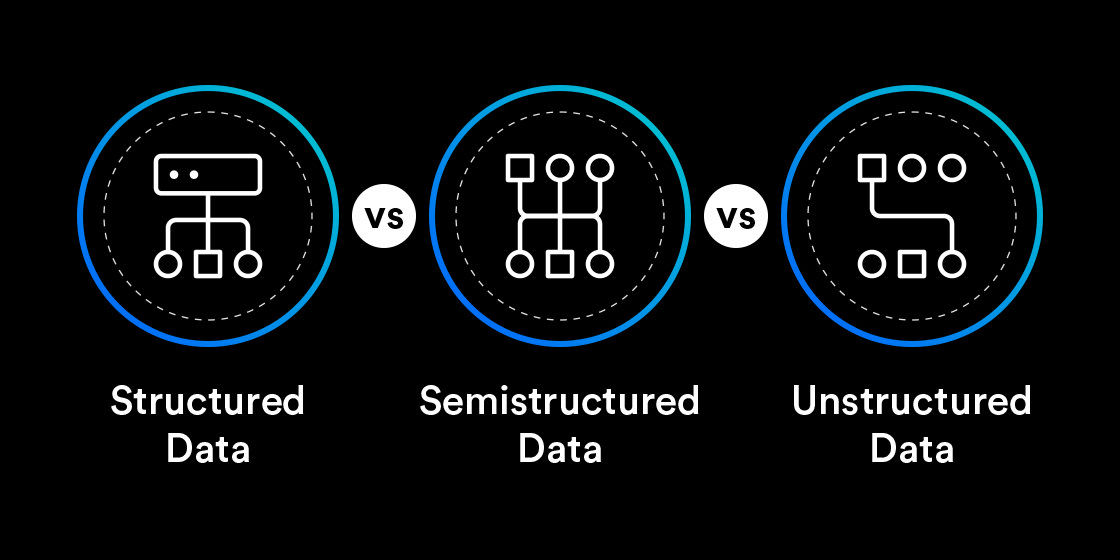
    From left to right, the image shows symbols of unstructured data, semi-structured data, and structured data.

    Structured, semi-structured, and unstructured data each possess distinct characteristics that impact how businesses operate. Each type can also impact decision-making differently, so having a deeper understanding of the nuances and implications is critical for modern business leaders to grasp.

    This blog will explore the distinctions between structured, semi-structured, and unstructured data. We will explore each data type’s characteristics, challenges, and unique opportunities for businesses operating in the data-driven era. Finally, we will discuss how enterprises can use modern AI-driven intelligent document processing (IDP) to navigate the growth of unstructured data and “unlock” the intelligence “stuck” in documents.

    Keep in touch

    Structured data vs. semi-structured data vs. unstructured data

    In the world of big data, information can be grouped into two distinct categories: “structured” and “less structured.” Structured data is information that follows predefined “rules” or “guidelines,” such as data points organized into a database. “Less structured” information is essentially everything else. 

    “Semi-structured” and “unstructured” data is information that can be grouped into the category of “less structured.” When information is locked away in documents, for example, these terms can often be confusing because all documents (structured, semi-structured, and unstructured) are generally considered “unstructured data.” Having said that, structured data (as in data in a database) is not considered “unstructured” data. 

    Unstructured data requires processing with AI before you can store or query its contents in structured formats like a database table or JSON. However, the key understanding to have is that “data,” no matter where it is stored, is your organization’s most valuable asset. There is valuable information in customer emails, social media posts, chat transcripts, competitor websites, invoices, contracts, and many other types of business documents. But the value within remains unobtainable if you can’t unlock the intelligence trapped in document-centric processes. 

    If you can’t unlock the intelligence trapped in document-centric processes, then the value within remains unobtainable. 

    Critical data points in business documents—whether “stuck” in structured, semi-structured, or unstructured documents—are the valuable intelligence your organization must “unlock.” Eliminating the “friction” in the way of potential business intelligence is the key to unlocking enhanced employee and stakeholder decision-making. In the next section, we’ll take a closer look at the differences between structured, semi-structured, and unstructured data types and investigate some common business use cases for each one. 

    The goal of intelligent document processing is to convert structured, semi-structured, and unstructured documents into structured data. Therefore, we will begin with the most accessible data type: structured data. This will deepen your understanding of the unique challenges and opportunities for each data type and the documents that store them.

    What is structured data?

    For all practical purposes, everything people try to extract from documents is “structured data.”

    Structured data is any information organized into a format that’s easy for traditional machines to find. Documents with structured data typically follow a “fixed” layout and usually contain fields with text, values, and other organized data—such as fixed forms, spreadsheets, or databases.

    Examples of documents with structured data

    Structured data typically includes text and other values stored in tables or databases. For a comprehensive list of the most common examples of structured data in business documents, check out the table below:

    Structured data

    Relational database tables

    Tables with predefined columns and rows representing attributes or fields containing individual data, such as text, numerical values, or code.

    Spreadsheets (e.g., Excel)

    Machine-printed text and numerical values are organized into cells, rows, and columns for easy sorting, filtering, and analysis.

    SQL tables

    Structured Query Language (SQL) tables are used in relational databases to organize and store structured data, enabling efficient querying and manipulation.

    ERP system data

    Structured data is captured and stored in Enterprise Resource Planning (ERP) systems and covers various business processes such as sales, inventory, finance, and human resources.

    Inventory management systems

    Data captured in Inventory Management Systems include product codes, quantities, prices, and physical warehouse locations that are structured and organized for efficient tracking and management of inventory.

    Financial transaction records

    Structured financial data that includes dates, amounts, account numbers, and transaction types, which are essential for financial analysis and reporting.

    Advantages of structured data

    The biggest advantage of documents with structured layouts is that the information is already designed and optimized for quick and easy processing by computer systems. This also makes the data easily searchable with traditional “rules-based” automation tools. 

    Because the data is highly organized and “structured,” it’s easier for legacy automation software like robotic process automation (RPA) to find critical data points. This also makes it easier for widely accessible but outdated technologies, such as legacy Optical Character Recognition (OCR), to scan and capture the data faster than manual human effort. 

    Simply put, structured documents require less advanced technology, which can benefit organizations that are reliant on older heritage document processes and legacy data systems. 

    However, these are not the only organizations that reap the benefits. Because structured documents are easier to process, nearly every industry can benefit from the value they store.

    Here are some more strategic advantages of structured data:

    • Structured data enables efficient data retrieval and querying.
    • Structured data is easy to store, organize, and access for further processing.
    • Structured data facilitates consistency and accuracy to ensure good data quality.

    What are the limits of structured data?

    Researchers at the IDC discovered that more than half of the documents enterprises process have structured layouts. However, most organizations cannot rely on structured data alone. 

    For example, what about handwriting? Fixed forms and other structured documents typically have additional fields reserved for signatures and handwritten checkmarks. 

    These documents may be easier for traditional automation tools to process, but they provide little flexibility. Plus, if they do contain unstructured elements, such as handwriting, then traditional “rules-based” technologies will struggle, which leads to critical information being missing.

    When dealing with modern omnichannel data sources that lack a well-defined structure, such as social media, email, or even handwritten content, it’s crucial to understand the limits of traditional rules-based extraction techniques. 

    Understanding these limitations can help you make a more informed decision about the strategies that unlock the business value in structured and less structured documents. 

    What is semi-structured data?

    Semi-structured data is information that does not exist in a structured or fixed format per se, such as a database or spreadsheet, but may have some attributes that make it easy to find. Some examples include XML documents, JSON files, and NoSQL databases. It’s also worth mentioning that there are no documents that contain “semi-structured data,” but there are plenty of examples of semi-structured documents. 

    Examples of documents with semi-structured data

    When we talk about “semi-structured” in the context of intelligent document processing, we are referring to documents where the same pieces of information are present across a variable layout. 

    Documents with semi-structured data conform to a template, but the information layout is flexible and likely varies from document to document. In the context of IDP, we are not talking about documents that contain XML or JSON data. We are talking about business documents made up of plain text, tables, and other elements that are based on evolving templates. 

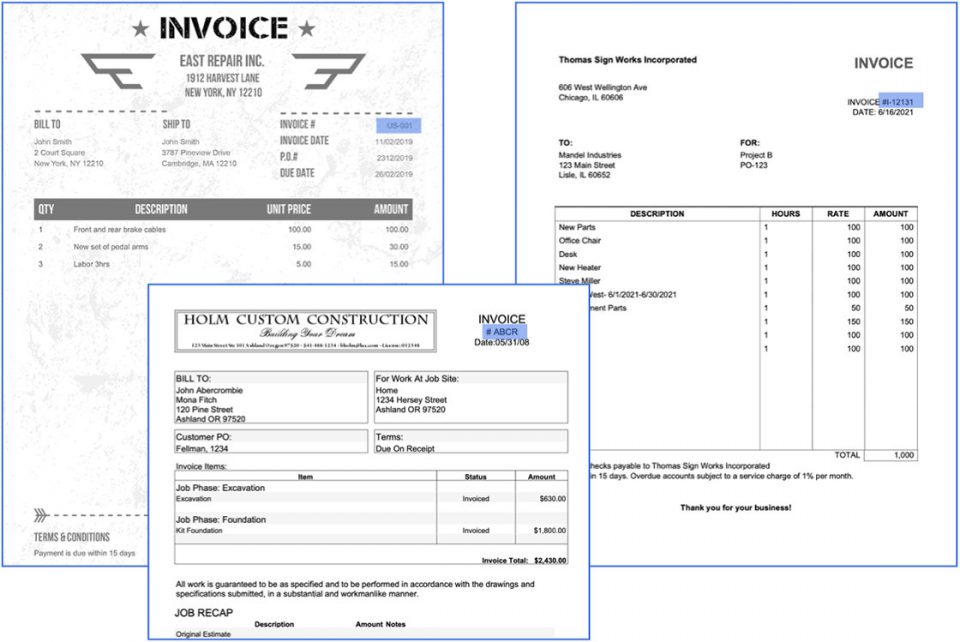
    Since semi-structured documents do not have “fixed” or standardized layouts, organizations handling them may need help predicting where the information of interest is located. Examples of semi-structured documents include invoices, purchase orders, bill-of-materials (BOM), receipts, and loan applications. 

    Check out the table below for a comprehensive list of semi-structured data examples:

    NoSQL Databases

    Flexible, schema-less data storage. Accommodates semi-structured or unstructured data. NoSQL databases, such as MongoDB, Cassandra, and CouchDB, store data in a flexible, schema-less format. This means that the data in NoSQL databases can have varying structures or fields across different documents or records. Semi-structured data in NoSQL databases can include diverse datasets such as user profiles, product catalogs, sensor data, social media feeds, and unstructured text documents.

    JSON (JavaScript Object Notation) is a lightweight data-interchange format. It is commonly used for storing and transmitting structured data, making it suitable for representing complex objects, arrays, and various data types. It is widely used in web APIs, configuration files, and data storage. Examples of semi-structured data in JSON include user profiles, product catalogs, and social media posts.

    XML (eXtensible Markup Language) is a markup language used for storing and transporting structured data. It uses tags to define elements and attributes to provide additional information about those elements. XML is versatile and allows for custom data structures. Semi-structured data in XML can include documents such as invoices, scientific data, and electronic health records. It is widely used for data interchange, configuration files, and data representation in various domains.

    HTML (Hypertext Markup Language) is the standard markup language for creating web pages. HTML documents consist of tags and attributes that structure and present content on the web. HTML is primarily used for defining the structure and layout of web pages, the content within HTML documents can vary in structure, formatting, and data representation. Examples of semi-structured data in HTML include web scraping results, online articles, blog posts, and forum threads.

    Advantages of semi-structured data

    Semi-structured data bridges the gap between structured and unstructured data types. Understanding the distinct advantages can help business leaders appreciate the value of incorporating semi-structured data into their document processing workflows. 

    Here are some of the key benefits of semi-structured data:

    1. Data analysis

    Semi-structured data often contains more contextual information than traditional structured data. Examples of this include metadata or tags that provide additional context that can improve the accuracy and relevance of data analysis.

    2. Flexibility 

    Semi-structured data is more flexible in data storage and data management scenarios compared to rigidly structured documents. Since semi-structured documents do not follow a strict, predefined template, incorporating new data types into existing databases or data pipelines is easier.

    3. Scalability 

    Semi-structured data is more scalable than structured data. Semi-structured data can be stored and processed using distributed computing systems in a variety of locations, such as existing on-prem databases, data lakes, and cloud storage. This flexibility and scalability enable greater agility to handle massive amounts of data.

    4. Integration 

    Semi-structured data easily integrates with other types of data, such as unstructured data, making it faster to combine and compare data from multiple sources.

    Challenges of semi-structured data

    While semi-structured data offers significant advantages, it also presents unique challenges that business leaders must consider when working with diverse data types. Understanding these challenges is essential to effectively managing and leveraging the potential of this data type. 

    Here are the key challenges with semi-structured data:

    1. Data extraction and integration 

    Semi-structured data can be more challenging to extract and integrate than structured data. It often requires specialized tools such as intelligent document processing (IDP) with custom Context-aware OCR data extraction data extraction processes to capture the relevant information from various formats and sources. Because semi-structured documents have varying templates, their improved flexibility can make data integration more complex. Additional efforts and sophisticated AI tools are needed to harmonize and align the different data elements.

    2. Data quality and consistency 

    Ensuring data quality is much more demanding in semi-structured data environments. The lack of strict data models and schemas can lead to inconsistencies, duplications, and discrepancies that compromise the quality of the data. Cleaning and standardizing semi-structured data requires either extra attention from humans or sophisticated AI technology to address variations in data formats, missing fields, and inconsistent datasets.

    What is unstructured data?

    Unstructured data is information that is not organized into any particular format and may be completely “free-form.” Examples of unstructured data might include photos, videos, emails, books, social media posts, health records, and legal contracts.

    Examples of documents with unstructured data

    Unstructured documents are “unfixed” and do not follow a templated design, a fixed layout, or “rules.”

    Gartner defines unstructured data as machine-printed or handwritten content lacking predefined rules or guidelines that computers traditionally use to identify. Unstructured data could be free-form text, such as the body of an email, or non-textual, such as a photo containing handwriting—but it could also exist in a non-relational database—such as NoSQL. 

    The table below lists some of the most common examples of unstructured data in business documents:

    Data Type

    Handwritten text or documents that lack a predefined structure. Unstructured data includes personal notes, letters, signatures, and any other text produced by hand. Examples: handwritten letters, personal diaries, meeting minutes, and signatures.

    Images, photographs, or graphics that contain handwriting, machine-printed text or important symbols. These data points are unstructured as they don’t adhere to a predefined format. Examples: logos, illustrations, and digital photos of handwritten notes or scanned images of business documents.

    Text Documents

    Unstructured textual data such as articles, books, emails, and reports. This data lacks a predefined structure and can vary in length, language, and formatting. Examples: PDF news articles, research papers saved as a Word document, and email messages.

    Free-form Notes

    Unstructured notes, memos, or annotations created by individuals. They can contain text, diagrams, sketches, or any other form of personal record-keeping. Examples: personal journals, meeting notes, brainstorming sessions.

    Speech Transcripts

    Transcriptions of spoken language, such as interview recordings or speech-to-text conversions. These data points capture spoken words, including dialogues, speeches, and conversations. Examples: interview transcripts, meeting minutes, voice recordings, and podcast episodes.

    Unstructured email messages and their attachments. Emails can contain text, images, and various file attachments. They often exhibit varying structures and content types. Examples: personal emails, business correspondence, newsletters.

    Social Media Posts

    Unstructured data shared on social media platforms, encompassing text, images, videos, or a combination thereof. It includes user-generated content, hashtags, and engagement metrics. Examples: tweets, Facebook posts, Instagram stories.

    Competitor Websites

    Websites contain both structured and unstructured data. While the overall structure, using HTML and CSS, is semi-structured, the unstructured data within websites includes text content, tables, images, videos, and other media elements. Examples: web pages, blog sites, and online forums. Unstructured data extracted from websites using web scraping techniques includes product listings, customer reviews, and news headlines.

    Sensor Data

    Unstructured data captured by sensors or IoT devices, including raw measurements, signals, or streams of data. It often represents real-world phenomena and lacks a predefined structure. Examples: temperature readings, accelerometer data, air quality measurements.

    Advantages of unstructured data

    Understanding the distinct advantages of unstructured data can help business leaders “unlock” the business value stuck in unconventional documents. 

    Here are some of the key advantages you get when you leverage unstructured data:

    1. Unlocked business value 

    You have a lot of unstructured data. Unstructured data is a business’s most valuable asset. It is the raw conceptual material and intellectual property that are a goldmine of untapped information for advanced analytics. The research estimates that unstructured data accounts for a whopping 80-90% of all new enterprise data. Yet only 18% of businesses are actually able to take advantage of it. The other 82% need help unlocking the business intelligence in this valuable resource. 

    2. Intent and sentiment analysis

    Unstructured data opens the door to advanced analytics techniques such as sentiment and intent analysis. For example, customers use email for all kinds of requests, and sometimes they have more than one request. It’s interesting to know that every 24 hours, there are more than 3 billion business emails sent and received worldwide. Intent classification detects customer intent in emails, and then it can automatically categorize emails based on intent to help automate email processing and triaging. 

    Sentiment analysis provides insights into customer opinions and emotions, allowing organizations to gauge brand sentiment, improve customer satisfaction, and address issues promptly.

    3. A big competitive advantage

    By leveraging advanced analytics techniques, businesses are able to uncover patterns, trends, and relationships that might go unnoticed. These invaluable insights enable organizations to make data-driven decisions that give them a competitive edge.

    Challenges with unstructured data

    Your unstructured data offers the most significant competitive advantages of all the data types. But it also presents the widest set of challenges to enterprise organizations. Understanding the challenges is essential to unlocking the business value stuck inside unstructured documents.

    Here are the key challenges involved with unlocking unstructured data:

    1. Data extraction 

    Since the information in unstructured documents does not follow a predictable pattern, their contents are entirely “hidden” from traditional data extraction methods. 

    2. Handwriting recognition

    Standalone Optical Character Recognition (OCR) is a ‘rules-based” technology that recognizes machine-printed letters, numbers, symbols, and even some handwriting. However, traditional OCR technology still struggles to accurately process handwriting. If your OCR cannot “see” unstructured handwritten signatures, tables, and other nuances accurately, someone must manually review the documents to extract the information. This stops your automation. 

    3. Data accuracy and quality

    OCR best suits high-quality scanned images with higher contrasts between texts and backgrounds. But if the text is splotchy or the scan is low-quality, OCR’s accuracy drops dramatically. Even with the best scanners and the best document quality, you only get 60% accuracy with traditional OCR at best. For enterprises looking to improve data processing speed, accuracy, and agility in unstable digital markets, rules-based approaches simply don’t cut it.

    4. Data privacy and security

    Unstructured data is the lifeblood of your business. It should never appear on public platforms. Proprietary data, such as chat transcripts, emails, multimedia content, patent applications, legal contracts, and even programming languages, can contain sensitive information with valuable intellectual property. Protecting data from unauthorized access, implementing proper encryption methods, and complying with relevant data protection regulations are essential.

    5. Scalable storage concerns

    Unstructured data,  typically large in volume and diverse in formats, presents challenges in storing, processing, and retrieving the data efficiently. Traditional storage systems and analytical tools may need help to handle the scale and complexity of unstructured data, requiring businesses to invest in scalable storage solutions and advanced data processing technologies.

    6. Integration challenges

    Unstructured data often need more standardized formats and schemas, which may make integration with existing systems more challenging. Integrating unstructured data with structured or semi-structured data sources requires careful data mapping, transformation, and consolidation techniques to ensure seamless data flow and compatibility across systems.

    Conclusion

    Structured data facilitates efficient analysis and supports business intelligence by enabling organizations to derive crucial insights quickly. 

    Semi-structured data requires a more nuanced approach since businesses need to extract relevant information from various formats and sources before they can uncover potential insights. 

    Unstructured data presents both a challenge and an opportunity. Unlocking its potential provides the business intelligence that will give agile enterprises a real competitive advantage. 

    Structured data facilitates efficient analysis and supports business intelligence by enabling organizations to derive crucial insights quickly. 

    But how can enterprises truly know whether or not data has potential value if there’s too much “friction” to unlock it? The answer is Intelligent Document Processing (IDP).

    Transform your unstructured documents into structured data with our AI-driven automation platform today

    Learn how we helped Markerstudy reduce its claims processing time by 40%. Additionally, learn how we reduced total claim processing time by 80% for another multinational insurance partner — cutting down manual tasks from 10 minutes to just two minutes per claim.

    • Speak with an expert — tell us about your specific use case.
    • Get a personalized demo — schedule a demo, and our Heroes will get in touch!

    Keep in touch

  • Making sense of the rise of unstructured data | Automation Hero

    By 2025, data-sphere experts forecast that worldwide data will exceed 175 zettabytes—and this trend is growing so fast that our global storage capacity cannot physically keep up with the payload.

    This raises important questions: how much of this information should we store and save as “data”? But most importantly, how do enterprises “know” what data has value?

    Jun 14, 2023 by Craig Woolard

    The image shows a man removing his eye glasses as he studies the unstructured data on his computer screen with Automation Hero's intelligent document processing (IDP) software.

    In today’s digital age, unstructured data has become the lifeblood of modern business. Access to quality data is driving innovation, improving insights, and enhancing decision-making within the most agile organizations. But with the rise of unstructured data, modern organizations are faced with a new challenge: how to make sense of this massive data deluge.

    This blog will answer the question, “What is unstructured data?” Then, we will examine the global challenges that modern enterprises are facing as they navigate the rapid growth of unstructured data and its unique opportunities.

    Finally, we will discuss how data-driven enterprises can use next-gen AI-driven intelligent document processing (IDP) to “unlock” the business intelligence stuck in unstructured documents.

    Keep in touch

    What is unstructured data?

    Gartner defines the data in unstructured documents as machine-printed or handwritten content lacking predefined “rules” or guidelines. Traditionally, computers have had to be programmed to follow rules in order to locate information of interest in structured databases and related formats. 

    However, unstructured data that lacks predefined rules is much more common in the real world. Unstructured data could be free-form text, such as the body of an email, or non-textual, such as a photo containing handwriting. 

    Unstructured data is also challenging to capture. Traditional “rules-based” approaches, such as the ones used in standalone Optical Character Recognition (OCR) and Robotic Process Automation (RPA), are limited when it comes to extracting data that lacks structure

    For example, RPA “robots” are limited in their ability to learn from experience; the bots can only do what they are programmed to do and do not improve or adapt over time without human intervention.

    Consequently, since legacy technologies like RPA can only handle rules-based, repetitive tasks, they struggle to extract information from unstructured documents, which leads to critical information being missing.

    The global challenges of unstructured data

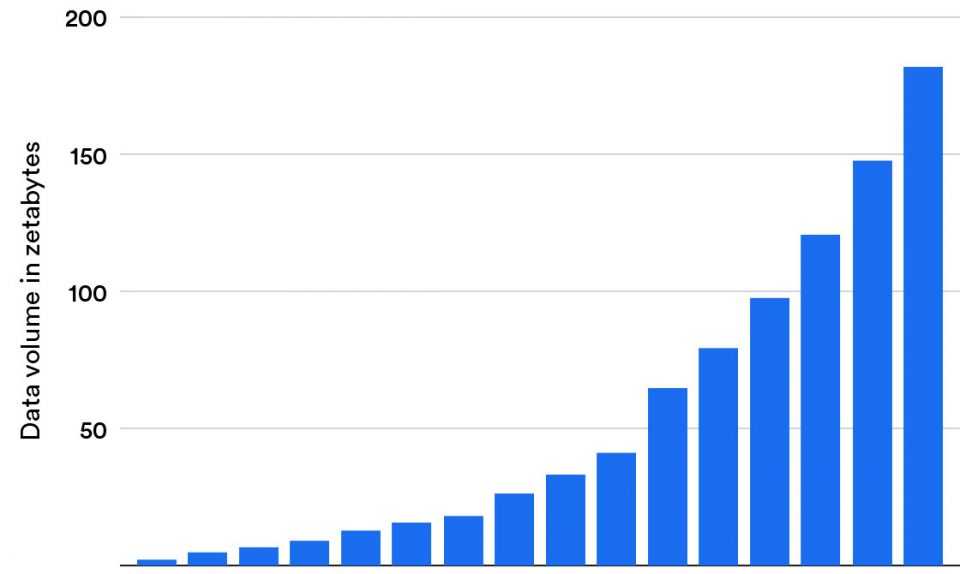
    The IDC Global DataSphere analyzes global data trends and reports on the quantity of data created worldwide. It also looks at how much data is stored across various storage media. In 2020, IDC researchers determined that the world produced more than 64 zettabytes of data.

    Since then, this global uptick in growth has skyrocketed so quickly that the amount of data we produce over the next five years is projected to outpace our global capacity to store it, meaning we save less of the data we create each year.

    In 2020, IDC researchers determined that the world produced more than 64 zettabytes of data.

    The chart shows the volume of unstructured data in zettabytes on the x-axis and the volume increase over time on the y-axis.

    By 2025, data-sphere experts have forecast that worldwide data will exceed 175 zettabytes. This trend is growing so fast that our global storage capacity, physically, cannot keep up with the payload. In this current reality, it raises an important question: how much of this information should we store and save as “data”? 

    …this global uptick in growth has skyrocketed so quickly that the amount of data we produce over the next five years is projected to outpace our global capacity to store it, meaning we save less of the data we create each year.

    Since the cloud increasingly determines how we store, consume, and engage with information, the rate at which enterprises produce data is double that of consumers. While not all data created is mission-critical or needs to be saved, how can enterprises determine what data has value?

    Understanding the growth of unstructured data within organizations

    Big data experts estimate that unstructured data accounts for 90% of all new enterprise data. This trend reveals that unstructured data is growing 55-65% every year—a rate three times faster than the growth of structured data. Yet only 18% of organizations are taking advantage of unstructured information.

    The reality is that the bulk of an organization’s data today is “unstructured.” That’s because modern customer information comes in many forms:

    • emails
    • text messages
    • social media posts
    • PDFs
    • handwritten scanned documents, and more.

    Without a method to mine valuable data from these documents, an organization is simply unable to adapt to changing conditions. So what about the other 82%? These organizations lack the technology to “unlock” business intelligence stuck in their most valuable resource: unstructured documents.

    If you can’t unlock the business intelligence trapped in legacy document processes, then the value within remains unobtainable. 

    The capability to unlock valuable intelligence is severely blocked within organizations with highly regulated document-centric processes, such as banking institutions. Older heritage document processes are a real barrier to digital transformation. If you can’t unlock the business intelligence trapped in legacy document processes, then the value within remains unobtainable. 

    So what can be done about it?

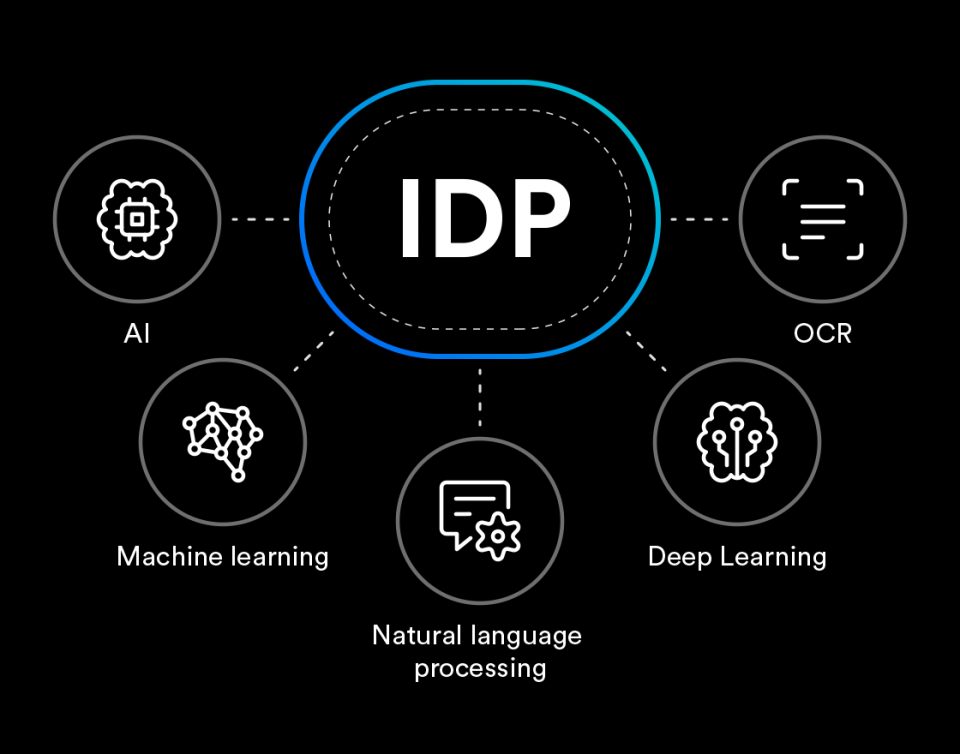
    The image shows how business leaders can leverage the technologies in intelligent document processing to unlock unstructured data. The technologies represented in the image are AI, Machine Learning, Natural Language Processing, Deep Learning, and OCR.

    How IDP overcomes the challenges of unstructured data

    Intelligent document processing (IDP) is a type of business workflow automation that uses next-gen artificial intelligence (AI), machine learning (ML), and natural language processing (NLP) to read documents like humans. 

    IDP brings modern AI/cognitive capabilities to workflow automation software, enabling organizations to reduce errors and improve the accuracy of their data. Many tasks, including data entry, automated document classification, and data extraction, can be successfully automated with IDP.

    The main goal of IDP is to transform your organization’s semi-structured and unstructured documents into useful, structured data.

    IDP can also integrate data with existing SAPs, ERPs, accounting software, databases, and legacy RPA tools—creating the most advanced solution for the global challenges of rapidly growing unstructured data. 

    The main goal of IDP is to transform your organization’s semi-structured and unstructured documents into useful, structured data. No matter what documents your organization handles, IDP scans content and interprets context—along with the author’s intent—to streamline the entire document workflow with above-human accuracy.  

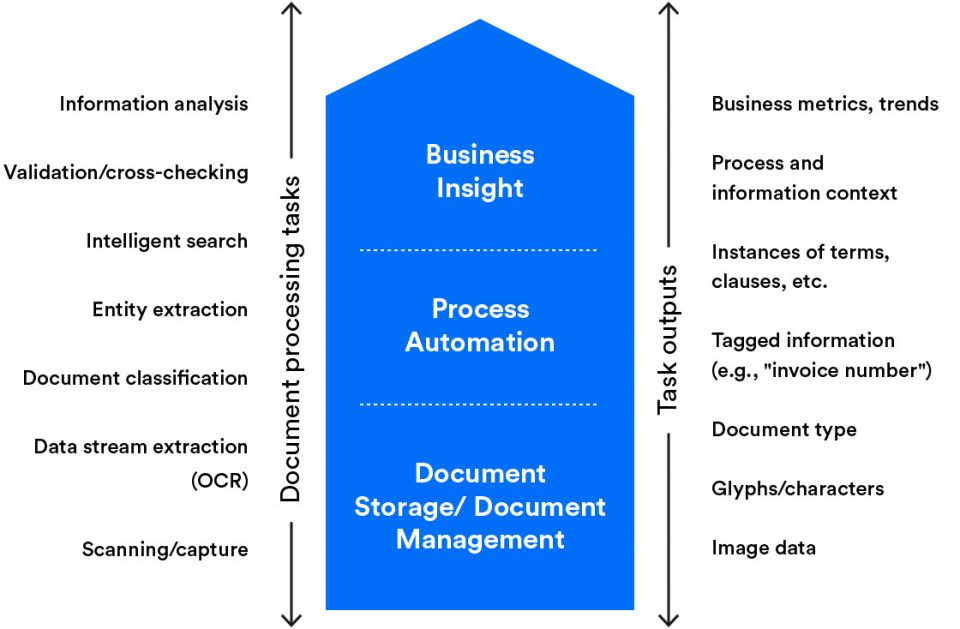
    The image helps business leaders visualize how intelligent document processing (IDP) helps organizations transform unstructured data into accessible data for enhanced document management, processing automation and decision-making.

    Since IDP aims to convert unstructured and semi-structured documents into structured data, intelligent document processing offers organizations the modern AI-driven automation technology they need to unlock the intelligence stuck inside any document. This leads to a wide range of business use cases, including invoice processing, contract automation, and automated email classification and processing systems.

    Organizations that leverage next-gen IDP technology to transform unstructured data into accessible data that is easy to use will come with many competitive advantages—but the immediate benefits are:

    • faster processing speeds
    • more efficient business processes
    • streamlined document management workflows
    • improved data quality,
    • enhanced decision-making

    For a complete understanding of intelligent document processing and the use cases that can help your organization, check out our Guide to Intelligent Document Processing for more.

    Conclusion

    Unstructured data presents both a challenge and an opportunity. Unlocking its potential provides the business intelligence that will give agile enterprises a real competitive advantage. But how can enterprises know whether or not data has potential value if there’s too much “friction” to unlock it? The answer is Intelligent Document Processing (IDP).

    Transform unstructured data into business value with our AI-driven automation platform today

    Learn how we helped Markerstudy reduce its claims processing time by 40%. Additionally, learn how we reduced total claim processing time by 80% for another multinational insurance partner — cutting down manual tasks from 10 minutes to just two minutes per claim.

    • Speak with an expert — tell us about your specific use case.
    • Get a personalized demo — schedule a demo, and our Heroes will get in touch!
  • How AI-driven email automation improves CSAT | Automation Hero

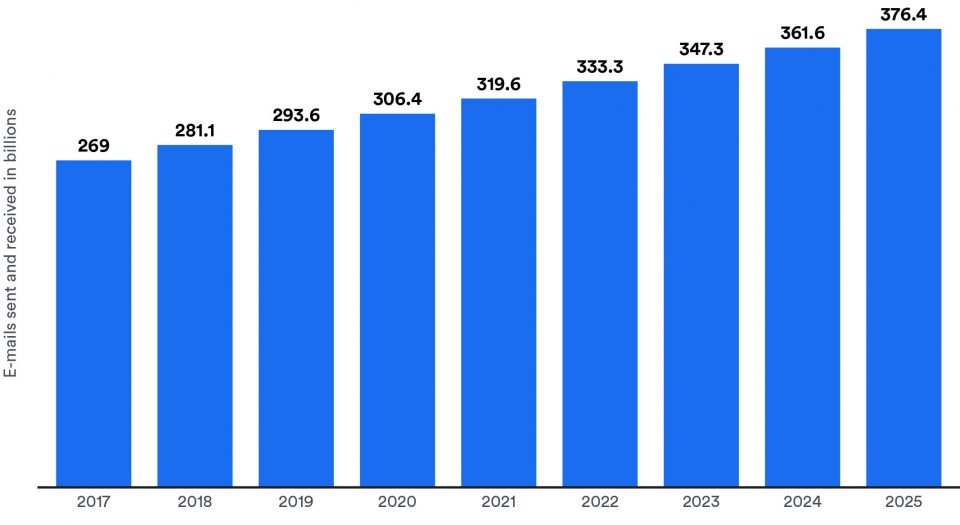
    Every 24 hours, more than 3 billion business emails are sent and received around the world. Just let that sink in… By 2025, global data experts forecast daily email traffic will grow to over 4.5 billion emails.

    Modern enterprises need an automated email classification and processing system to manage the overload of incoming customer emails and triage messages more than ever.

    Jun 13, 2023 by Craig Woolard

    A woman ponders email processing and email processing systems.

    How many emails does your team receive each day? Hundreds? Maybe thousands? How many emails include attachments of unstructured documents, such as PDFs, or even images of handwritten text? If emails continue growing steadily at a 4% rate yearly, global data experts forecast daily email traffic will grow to over 4.5 billion emails in 2025.

    Global data experts forecast daily email traffic will grow to over 4.5 billion emails in 2025.

    Emails sent and received in billions by 2025. Email processing can help.

    For many businesses, the volume of emails to manually read and sort gums up internal systems and leads to losses in productivity and revenue. As a result, an effective email processing system to manage modern omni-channel customer communications is needed more than ever.

    What is email processing automation?

    Email processing automation reads and handles emails just like a human would. It uses advanced artificial intelligence (AI) algorithms to automatically process incoming and outgoing emails—helping companies respond quickly with the right message at the right time. 

    This specific type of business process automation (BPA) leverages natural language processing (NLP) and other AI technologies to automate the routine tasks of email management. Some common examples of email processing automation include:

    • Reading, classifying, and routing emails to the appropriate individual or team.
    • Extracting data from the body of emails or their attachments.
    • Automating responses and pulling in additional information if needed.
    • Any combination of the above.

    Automating email processing can help teams manage large volumes of incoming emails, streamlining communication and workflows. But what about the essential information “locked away” in attachments containing “hard-to-reach” unstructured data?

    How does email processing automation work?

    These days, email attachments run the gamut of unstructured documents. They include critical information stuck inside unstructured PDFs, semi-structured forms, attached spreadsheets, infographics, presentation slides, text files, and even photos of handwritten text. So how do businesses extract essential data from these unstructured email attachments?

    How do businesses extract essential data from these unstructured email attachments?

    This image shows examples of email attachments that clog enterprise email inboxes with important documents. The image explains the various types of attachments that email processing automation can help with.

    A well-designed email processing platform can help companies completely automate these emails, so employees are free to focus on more mission-critical opportunities. Automated email processing consists of several parts:

    1. Unlocks critical data in emails and attachments.
    2. Understands intent and categorizes emails.
    3. Automates email triaging to the right department.
    4. Streamlines customer communication with the appropriate response.
    5. Transforms unstructured data into action.

    Why is automated email processing more efficient?

    Let’s say you’re a shipping company receiving hundreds of customer emails daily with requests—from price quotes to package statuses. Those emails may come in with attached jpegs or even relevant information that could be related to multiple requests—making it hard to build rules that sort things reliably.

    Figuring out who should see each type of information and responding with the right message takes hours of precious time from the shipping company’s staff.

    Figuring out who should see each type of information and responding with the right message takes hours of precious time from the shipping company’s staff. Furthermore, it slows down response times when customers know their requests can be answered quickly by the competition with first-class round-the-clock, 24/7 support.

    Streamlines internal processes

    Email overload significantly reduces productivity, morale, and company revenue. Industries worldwide are dealing with new complicating factors that have sent email volumes soaring, and the rapid growth in email traffic is far-reaching. Freeing your employees from these distractions is critical to maintaining high productivity levels. Email processing automation and AI can help you streamline so everyone wins.

    Email processing automation and AI can help you streamline so everyone wins.

    Subscribe to Content

    Efficiency boost equals more sales

    Streamlined business processes directly impact your team’s ability to focus on higher-value tasks, such as generating more revenue. For example, a claims adjuster juggles dozens of insurance claims when a natural disaster strikes. Automatically classifying incoming emails with photos of receipts and other unstructured policyholder data boosts efficiency when time is critical. 

    Streamlined business processes directly impact your team’s ability to focus on higher-value tasks, such as generating more revenue.

    Likewise, sending incoming RFP emails to the correct departments during the initial stage of the Request For Proposal process cuts down the work of generating price quotes—improving competitiveness against new industry players who have digital-only processes. 

    Enhances the customer experience

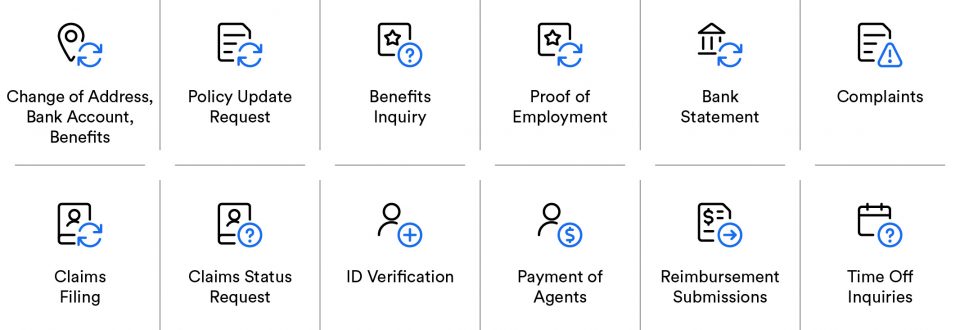
    Customer service teams face an ever-increasing amount of pricing requests, address changes, complaints, and many other inquiries. Automating email classification with intent detection cuts down on the emails your team needs to manually review and reply to so customers get help faster. The reduced workload also saves time for higher-value tasks that improve the customer experience.  

    …intent detection cuts down on the emails your team needs to manually review and reply to so customers get help faster.

    How Automation Hero can help you with email processing

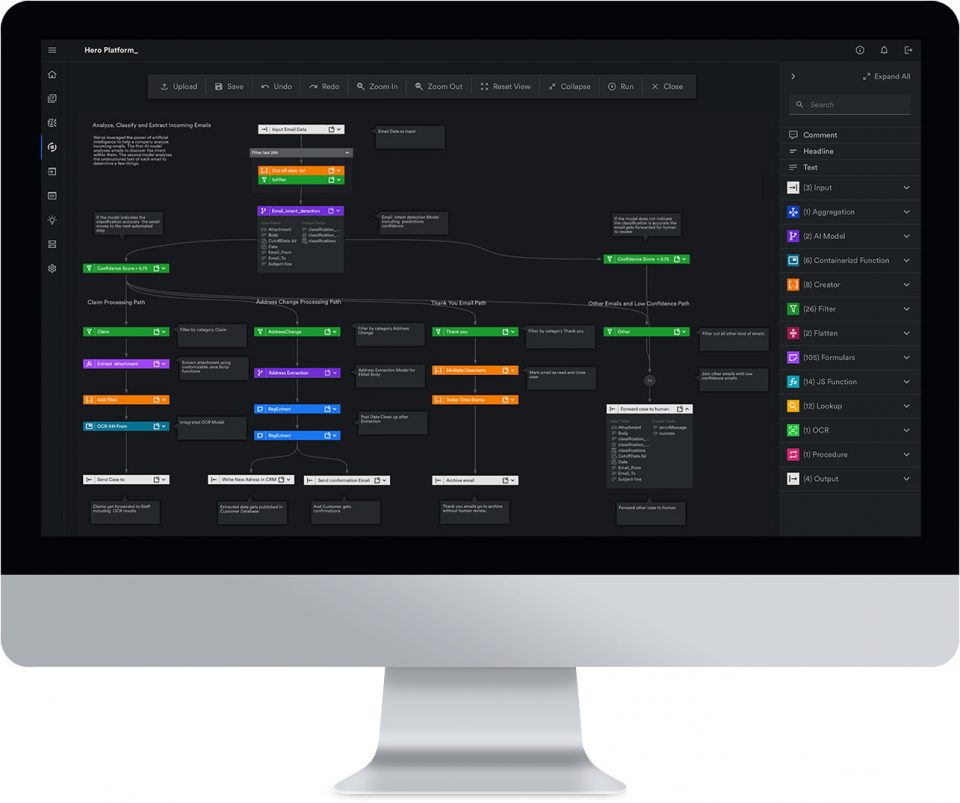
    Automation Hero’s Hero Platform_ is an end-to-end intelligent document processing (IDP) platform with native, next-gen AI and enterprise-grade email processing built-in. Hero Platform_  uses advanced AI models for each step of the automated email process. 

    Hero Platform_ understands, classifies, and manages any document—including incoming emails and attached files—such as scanned forms with handwritten text locked away inside invoices or pictures of receipts. 

    Additionally, our platform can even triage emails and extract essential information from the email content directly, along with the data locked inside unstructured email attachments.

    Say hello to Hero Platform_

    When a new email comes in, Hero Platform_ uses a classification AI model to classify the intent of the message. Is the email a quote request, a shipment update, or a request for support? Hero Platform_ detects the intent and intelligently sorts the email into an appropriate category. 

    The image shows a desktop computer with a Automation Hero's intelligent document processing platform on the screen to automate email processing and classification.

    Hero Platform_ then automatically collects key information from the message—such as the customer’s name, order details, or key dates mentioned, and generates a summary of the issue. 

    The captured data is then used to verify the relevant customer account and order information stored in an internal database, saving your team time and effort. The extracted information could then go into a support ticket system that creates a new case—allowing your staff to focus on providing top-notch customer service instead of shuffling digital envelopes.

    Industry-leading AI reads, classifies, & extracts data from emails 

    Hero Platform_ has an advanced AI model that scans and understands the intent of emails. Our platform can automate fast responses or route emails to the proper departments based on intent. Hero Platform_ then automatically sorts and selects emails and can even send an automated response if additional clarification or supporting documents are needed. 

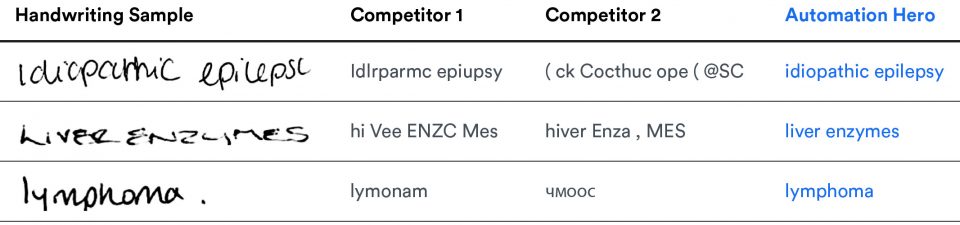
    Email attachments come in various formats—from PDFs to printed receipts to scanned paper images of handwritten text and jpeg files. Our AI-powered Context-aware OCR extracts the critical information from these documents in seconds.

    The image shows examples of handwritten text that an automated email processing and classification system can extract. Industry-leading AI reads, classifies, & extracts data from emails.

    Powered by industry-leading AI, our all-in-one Hero Platform_ comes equipped with the most accurate OCR on the market that reads documents like a human—especially handwriting. 

    End-to-end automation

    Hero Platform_ is an end-to-end intelligent document processing platform that reads documents—even handwriting and tables—the same way as humans. It uses advanced AI to extract essential data locked away in emails and transforms it into business value. Once unlocked, Hero Platform_ can even read the data in multiple languages, allowing other departments operating in different countries to reuse it. 

    Once unlocked, Hero Platform_ can even read the data in multiple languages, allowing other departments operating in different countries to reuse it. 

    Likewise, IDP can enter the data into accounting software or an internal database—such as an ERP, ECM, or CRM system. With the data extracted, Automation Hero can look up information in another system, verify it, and automatically compose and send replies to customers with the appropriate responses. 

    Accelerate responses—with a human touch

    Plus, humans can interact with the automation as needed. Hero Platform_’s attended automation flags all remaining emails for employees to review using a human-in-the-loop interface for quick batch review. Our no-code environment is highly configurable and provides all relevant information employees need to make decisions quickly.

    With Automation Hero, no more emails can slip through the cracks. So say goodbye to mishandled requests and hello to human-in-the-loop.

    Industry-leading intent detection—built in

    The faster your teams can detect and respond to leads that might signal an intent to purchase, the greater the odds of making a sale. Hero Platform_ automatically extracts key data points from the email—such as the customer’s name, order details, or dates—and generates a summary of the issue. Our flexible AI intent classifiers rapidly identify interested clients, equipping sales teams with the valuable business intelligence they need to close a deal.

    The faster your teams can detect and respond to leads that might signal an intent to purchase, the greater the odds of making a sale.

    Automatic email routing and triaging

    Email triage—quickly sorting through a clogged inbox—is daunting no matter what business you’re in. What is the email’s main topic? What type of request is the customer making? Does the information need to be validated by an internal database or an employee? With an accurate understanding of the sender’s intent, these are instantly turned into actions.

    Unclog the shared inbox and say goodbye to mishandled requests for good.

    Unclog the shared inbox and say goodbye to mishandled requests for good. Our automated email classification system instantly triages emails with above-human accuracy, so employees aren’t constantly in over their heads.

    Email processing automation case study 

    A large global logistics and shipping company wanted to improve its customer experience when responding to price quote requests. For years, the company previously handled these requests manually, but as requests shifted to fax, email, and other digital communications, the company was swamped. 

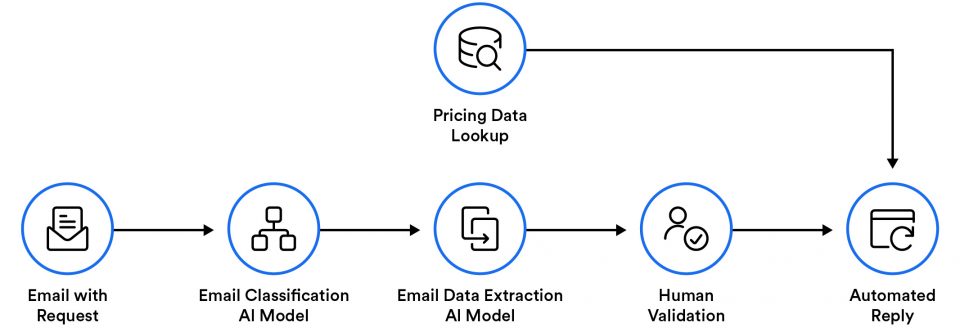
    Due to the variety of unstructured data contained in these requests, the company needed a way to keep up with the volume of inquiries from multiple channels. Using Hero Platform_, the company automated responses for 60% of the incoming inquiries, which reduced the workload by 80%—streamlining faster responses that increased customer satisfaction. 

    Email processing automation case study example show the steps involved in an automated email processing and classification system.

    Automation and AI can help you streamline too. For example, see how we helped this global logistics company streamline email processing down to mere seconds in response time—all with Hero Platform_.

    Unclog the shared inbox with an AI-driven email classification and processing system today

    Learn how we helped Markerstudy reduce its claims processing time by 40%. Additionally, learn how we reduced total claim processing time by 80% for another multinational insurance partner—cutting down manual tasks from 10 minutes to just two minutes per claim.

    • Speak with an expert — tell us about your specific use case.
    • Get a personalized demo — schedule a demo, and our Heroes will get in touch!
  • Unlocking the business value in different document types

    In the world of enterprise data management, business documents come in all shapes and sizes—each with its own characteristics and challenges.

    But the differences between structured, semi-structured, and unstructured documents cause a world of confusion. This blog article unravels the distinctions between these document types.

    Jun 01, 2023 by Craig Woolard

    A man is holding a laptop with an intelligent document processing (IDP) software installed to unlock the business intelligence in unstructured documents.

    Understanding the differences between “structured,” “semi-structured,” and “unstructured” documents is crucial for effective information processing and decision-making.  

    In this article, we delve into the distinctions among these document types, shedding light on their unique attributes and the implications they have for businesses. You will also learn that “less structured” documents require significantly more advanced technology.

    That’s where IDP comes in. With Intelligent Document Processing (IDP), businesses can at last “unlock” the business value “stuck” in unstructured documents. Gain a clear understanding of the many types of documents and harness the power of structured data. Let’s dive in.

    Keep in touch

    “Structured” vs. “less structured” documents

    Essential data can be organized in a variety of ways, and this presents all kinds of challenges. 

    For one, the terminology and industry jargon cause a lot of confusion. To simplify it, there are two ways information can be organized in a document: “structured” or “less structured.” The table below breaks down the most common business documents by type:

    Structured documents

    Semi-structured documents

    Unstructured documents

    Printed forms

    Social Media posts

    Tax Documents

    For example, there’s a lot of “unstructured data” packed away in business contracts.

    You might be unable to stick a contract into a database and run queries against it. But you can use AI to extract data points—such as “supplier name,” “supplier address,” “contract termination date,” and other pieces of critical information—from those documents.

    But how can enterprises know if documents have potential value or not? That’s the other challenge to address with business documents. 

    The challenges with structured, semi-structured and unstructured documents

    These terms can often be confusing because all documents (structured, semi-structured, and unstructured) are generally considered “unstructured data.”

    They all require processing with AI before you can store or query their contents in structured formats. Let’s quickly examine the major challenges businesses confront with each document type:

    1. Structured documents

    With “structured” documents, such as a fixed form, you already know what you will find and where to find it within the document. 

    You already know what you will find and where to find it within the document. 

    2. Semi-structured documents

    On the other hand, the layout is a lot more flexible and prone to change in a “semi-structured” document, such as an invoice. Even though you may already know what you will find in a semi-structured document, you will have no idea where to find it or how to predict the location of the essential data. 

    Even though you may already know what you will find…you will have no idea where to find it or how to predict the location of the essential data. 

    3. Unstructured documents

    To make matters worse, “unstructured” documents, such as emails, social media posts, and contracts, are completely “free-form” and massive in volume. These documents are the most challenging to predict. You have no idea what you will find or where to find it. Just by sheer volume, unstructured documents need rich language understanding to “unlock” the potential business intelligence they likely have.  

    You have no idea what you will find or where to find it.

    How does intelligent document processing overcome these challenges?

    In intelligent document processing (IDP), documents are categorized based on their structure (or lack thereof) and by the predictability of their content. 

    Flexible documents require flexible AI models to understand and extract the data. Fixed forms are easy to predict and require less flexible AI. The more flexible documents you have, the more sophisticated AI you need.

    No matter what type of document your organization processes, IDP can help you unlock the business value in any document. In the next section, we’ll take a closer look at the differences between structured, semi-structured, and unstructured documents.

    1. Examples of “structured” documents

    Nearly every industry heavily relies on structured documents in one form or another. 

    These include documents containing machine-printed text designed to be scanned by computers, such as identification records, passports, ID cards, and driver’s licenses.  

    Structured documents also typically involve fixed forms, including tax forms, questionnaires, surveys, tests, medical records, and insurance forms. For a comprehensive list of the most common examples of structured data in business documents, check out the table below:

    Document type

    Structured documents designed for collecting specific information, often used for applications or surveys.

    Official identification cards issued to individuals, containing structured data such as name and photo.

    Travel documents issued by governments, containing structured data including personal and travel details.

    Documents used for filing taxes, containing structured fields for reporting income, deductions, and more.

    Structured documents containing the patient’s medical history, diagnoses, treatments, and other healthcare data.

    Simply put, structured documents require less advanced technology, which can benefit organizations that are reliant on older heritage document processes and legacy data systems. 

    However, these are not the only organizations that reap the benefits. Because structured documents are easier to process, nearly every industry can benefit from the value they store.

    It’s also worth mentioning that even with very structured documents, there are still many areas where AI can help. Those include detecting the fixed elements in a larger page (like finding the ID card scan as part of a larger page), image cleanup, and processing difficult input such as handwriting.

    2. Examples of “semi-structured” documents

    Since semi-structured documents do not have “fixed” or standardized layouts, organizations handling them may need help predicting where the information of interest is located. Examples of semi-structured documents include invoices, purchase orders, bill-of-materials (BOM), receipts, and loan applications. 

    This image shows examples of invoices as an example of "semi-structured" documents.

    Check out the table below for a comprehensive list of common business documents with semi-structured data:

    Document type

    Invoices often contain structured fields along with unstructured information. They typically include structured data such as invoice number, date, and amount, while also incorporating unstructured information such as item descriptions and billing notes.

    Purchase orders typically have structured fields for order number, quantity, and price, but may also include unstructured information like special instructions or terms and conditions.

    Surveys may have predefined questionnaires but allow for open-ended responses. They provide structured data through predefined questions and response options, along with unstructured data through customers’ open-ended feedback and comments.

    Financial statements consist of structured financial data, such as balance sheets and income statements, but may also include narrative sections with qualitative information that provide insights into the financial performance of a company.

    Product Safety Data Sheets (SDS) provide information about the hazards, handling, storage, and emergency response measures for specific chemical products. While SDS documents have a defined structure, the content within each section can vary based on the specific chemical and regulatory requirements. This allows manufacturers to accommodate the varying properties and hazards of different chemical substances.

    Formal documents providing detailed information about the quality and composition of a product or material, typically including structured data such as batch/lot numbers, test results, specifications, and analytical information.

    Legal contracts have structured sections for parties, terms, and conditions, but may also contain unstructured clauses and appendices. Contracts include structured data with legal obligations and agreements between parties, while unstructured clauses and appendices provide specific details, exceptions, or additional terms that may vary from contract to contract.

    3. Examples of “unstructured” documents

    Unstructured documents are “unfixed” and do not follow a templated design, a fixed layout, or “rules.”

    The table below lists some of the most common business documents with unstructured data:

    Document type

    Emails contain unstructured data such as free-form text conversations, attachments, and metadata.

    Customer feedback documents, including surveys, comments, and reviews, contain unstructured data expressing opinions, suggestions, and experiences shared by customers.

    Support tickets in customer service systems often contain unstructured data in the form of customer inquiries, problem descriptions, and support agent responses.

    Social media messages, including direct and private messages, contain unstructured data consisting of customer inquiries, feedback, complaints, and other interactions with a business on social media platforms.

    Voice transcripts provide unstructured data by converting recorded phone calls or voicemail messages into text, capturing customer inquiries, sales discussions, or support interactions in a text-based form.

    How IDP transforms any document into structured data

    Legacy technologies like robotic process automation (RPA) and optical character recognition (OCR) can find the same data points in the same place every time (structured documents), but they struggle to do anything else. 

    When it comes to more flexible semi-structured and unstructured documents, RPA and OCR’s “brittle” interfaces are incapable of “seeing” the data points—so they simply break down, which stops your automation dead in its tracks. 

    Intelligent document processing (IDP) is a type of workflow automation that goes beyond the limitations of traditional RPA and OCR. It uses next-gen artificial intelligence (AI), machine learning (ML), and natural language processing (NLP) to “read” documents like a human and transform unstructured documents into structured data.

    Flexible documents require flexible AI models to understand and extract the data. The more flexible documents you have, the more sophisticated AI you need.

    IDP can also integrate structured data with existing software, databases, and legacy RPA tools—creating the most advanced hyper-automation solution for the global challenges of rapidly growing unstructured data. 

    This image shows a man wearing a yellow vest as he stands in a shipping warehouse. He is using the intelligent document processing software on his laptop to automate unstructured data.

    Intelligent document processing to the rescue

    No matter which business document your organization handles, IDP scans content and interprets context—along with the author’s intent—to streamline the entire document workflow with above-human accuracy. Here are the key IDP use cases to know about:

    1. Different file formats

    Business documents come in every format, including paper forms, PDFs, images, and emails. The AI deployed in intelligent document processing can read all of them—with a clear understanding of every word—and with greater accuracy and speed than traditional automation software can offer. 

    2. Scanned documents

    Companies around the globe struggle to extract information from scanned PDFs. This is especially the case with handwriting. However, IDP can intelligently classify, capture, and process stockpiles of business-critical data locked away in archives of scanned unstructured documents, regardless of the quality of the scan, file type, language, or handwriting legibility.

    3. Handwriting & signatures

    Optical character recognition (OCR) recognizes characters, letters, and numbers, regardless of the font. But as a standalone technology, OCR does not recognize handwriting accurately. But, when integrated with AI, cursive and signature detection improve significantly with IDP.

    3. Handwriting & signatures

    4. Invoice processing 

    Every vendor uses a unique invoice, and companies receive thousands of invoices with different requirements—each with critical data that must be manually keyed into an AP system. An invoice automation platform with sophisticated AI, can analyze invoices, find key data points, and automatically update existing systems. 

    5. Email processing

    Emails have some fixed properties, so they could be considered semi-structured documents. But the valuable information is contained in the body of the email and in the attachments. This essential data is generally unstructured. An email automation platform with intent analysis can analyze incoming emails, detect the sender’s intent, extract the data, automatically update relevant systems, and notify the sender about the outcome. 

    6. Contract automation

    Contracts are data-packed documents with critical business intelligence. Automation Hero’s IDP unlocks the business value in contracts with a certified, secure environment driven by industry-leading AI. Only Automation Hero’s sophisticated AI recognizes styles of handwriting and goes beyond plain text to extract all critical data points stuck in contracts in just seconds.

    Conclusion

    Structured data facilitates efficient analysis and supports business intelligence by enabling organizations to derive crucial insights quickly.

    The real challenge is extracting the unstructured information and making it actionable. This is the only way to discover the intelligence locked away in unstructured business documents.

    Structured data facilitates efficient analysis and supports business intelligence by enabling organizations to derive crucial insights quickly. 

    How can enterprises know whether or not data has potential value if there’s too much “friction” to unlock it? The answer is Intelligent Document Processing (IDP).

    Unlock the business intelligence in your documents with an AI-driven automation platform now

    Learn how we helped Markerstudy reduce its claims processing time by 40%. Additionally, learn how we reduced total claim processing time by 80% for another multinational insurance partner — cutting down manual tasks from 10 minutes to just two minutes per claim.

    • Speak with an expert — tell us about your specific use case.
    • Get a personalized demo — schedule a demo, and our Heroes will get in touch!
  • How to optimize loan processing with modern AI | Automation Hero

    Financial institutions of all shapes and sizes must perform KYC and due diligence checks. Both help verify the identity of new clients and any risks involved with doing business with them.

    However, this can involve a long, tedious exchange of documents. So, how can that exchange be shorter and less time-consuming? The answer often depends on how savvy a finance company has been at using automation.

    May 15, 2023 by Craig Woolard

    Applying for a loan is one of the most complicated processes borrowers will experience. It’s not exactly a walk in the park for lenders, either. Many banks are stuck in traditional, manual processes. Employees spend hours on laborious, repetitive computer tasks.

    Let’s look at a common example—the car loan application: 

    1. A potential client applies for a car loan. First, a bank associate enters the client’s data into a database and assesses the risk of taking out the loan. 
    2. If approved, the customer sends the vehicle details to the bank. 
    3. Next, the money is processed and wired to the dealership. 
    4. Finally, the customer provides proof of insurance and registration, which is again manually entered into the bank’s database. 

    Keep in touch

    This is just one example of an inefficient process. Most banks offer several different loans that are handled manually across various departments. 

    Maintaining a database requires hundreds of steps that are painfully manual. These tasks usually involve going back and forth between different systems (or “chair-swiveling”). The extra steps delay the loan application process and severely impact the client’s experience. This is where automation can play a major role.

    Technology that can eliminate manual copying and pasting between applications is a significant value proposition for legacy lenders. An automated loan processing system does away with chair-swiveling, data entry, manual document reviews, and many other tedious steps in the workflow. With automation, KYC, CDD checks, and customer onboarding processes are on the fast track.

    In this post, we will cover what loan processing automation is and how legacy lenders can automate and optimize loan processing with artificial intelligence (AI). We will detail use cases for intelligent document processing (IDP) in the loan application process, where it can be applied, and why this technology is changing how traditional banks operate. 

    At the end of the post, you will understand IDP and how it can cut down on loan processing times in your own financial institution.

    What is automated loan processing?

    Automated loan processing refers to software and technology that can streamline the lending process, from the initial application to the final loan approval. 

    With minimal human intervention, an automated loan processing system can automate many manual tasks involved in processing a loan, including data entry, credit checks, underwriting, and document validation.

    Implementing a loan automation system into a banking institution’s underwriting process reduces the time and resources required to process loans. Overall, automation improves accuracy and efficiency throughout the entire loan processing workflow.

    Who benefits from loan lending process automation?

    Customers 

    Loan automation doesn’t just help financial institutions. In addition to improving the efficiency of the loan processing workflow, this technology provides borrowers with a more convenient loan application experience. Faster access to funds is what it’s all about for customers. Less friction in the onboarding process enhances the customer journey and improves customer satisfaction. 

    Financial institutions

    Successfully processing each application involves extracting hundreds of data points and analyzing all of them to assess financial risk. With the proliferation of online lenders like Rocket Loans and other fintech startups, consumers expect near-instantaneous application approvals. But according to research by Ellie Mae—legacy lenders average 52 days to process a mortgage manually—from the date the application is submitted to the date the loan is disbursed. 

    Banking employees

    The main goal of loan automation is to streamline the lending process, making it faster, more accurate, and more efficient for both lenders and borrowers. The technology behind automation can also help employees.

    Loan officers handle many documents with data about a borrower’s income. Additionally, underwriters can review 20–30 data points per document. These all involve pay stubs, tax documents, bank statements, and even open-source content available on social media for a complete picture of all associated risks. Loan automation eliminates all of this manual work, allowing bank employees to focus on higher-value work that generates more revenue. 

    Applying for a mortgage is one of the most complicated and frustrating processes homeowners will ever go through. It’s not exactly a cakewalk for lenders, either. So why not make the journey less painful for both parties? In the next section, let’s discover what makes loan automation possible and how it can offer above-human accuracy.

    What makes automated loan processing possible?

    Advancements in technology—such as artificial intelligence (AI), machine learning (ML), optical character recognition (OCR), and data analysis—all make it possible for lenders to process loan applications and other financial services faster and more accurately than humans. 

    Combining these technologies drives most of the automation solutions currently on the market. For example, OCR leads the way, which can read any document just like a human underwriter would. However, when augmented with AI, OCR can extract information into usable data and even learn to process it far more efficiently and accurately than humans. 

    OCR is often used with several other automation solutions, such as robotic process automation (RPA), which automates repetitive actions humans perform on computers. Combined with AI, this enables intelligent document processing (IDP) capabilities, which mimic how humans understand information and make decisions. 

    Additionally, the availability of cloud-based software solutions and Application Programming Interfaces (API) enables lenders to integrate their loan processing systems with other digital platforms and services, such as online banking and mobile apps, creating a more seamless and efficient lending experience for borrowers.

    What are the limits of existing loan automation solutions?

    Some older, legacy automation technologies—such as RPA—rely on simple “point-and-click” screen automations that replicate the manual click-work and keyboarding of human underwriters. 

    By mimicking repetitive human-performed tasks, legacy RPA “bot” technology removes some of the rote busywork and human error in underwriting. However, RPA breaks easily and is difficult to update whenever modern, evolving workflow processes change.

    Underwriting, KYC, CDD checks, and customer onboarding are all complex processes that  require a thorough review of large amounts of incoming data from unstructured documents. The loan application process is a major area where traditional RPA falls short and requires significant human intervention. Watch this demo to learn more about where RPA falls short.

    Traditional RPA bots run on top of existing IT systems as a complementary solution. Since legacy RPA uses a “rules-based” template, it struggles to capture critical data from documents that do not follow a fixed layout. RPA, a legacy technology, has a reputation in the banking world for being “fragile,” inflexible, and difficult to maintain—driving much of the disillusionment about RPA as a “brittle” and unreliable technology. 

    The image shows a desktop computer with a Automation Hero's intelligent document processing platform on the screen to automate loan processing for a large enterprise.

    Why loan processing automation needs modern AI

    In traditional banking institutions, providing 24-hour support, responding to customer emails, approving applications, and organizing paperwork are all crucial to winning and retaining customers.

    Fintech apps are changing the lending industry by offering faster, more accessible, and more responsive front-end processes. Unfortunately, legacy lenders who are stuck in legacy document workflows prone to manual errors and RPA weak points really struggle to keep up with these technological advancements. 

    This gives a competitive edge to newer fintech startups. However, lenders that can digitally transform their loan application processes will be able to provide a seamless and frictionless lending experience. Therefore, what traditional lenders need more than ever is a modern AI-driven automation technology that brings financial services like the loan process into the digital era.

    In traditional banking institutions, providing 24-hour support, responding to customer emails, approving applications, and organizing paperwork is crucial to winning and retaining customers. Automated loan processing systems—with next-gen AI/cognitive document understanding—will close the gaps. 

    With intelligent document processing, legacy lenders are back in the driver’s seat.   

    How intelligent document processing (IDP) closes the gaps

    Next-wave loan automation platforms like Automation Hero streamline data extraction with above-human accuracy. For example, Automation Hero’s patent-pending context-aware optical character recognition (OCR) “reads” every kind of document (including images), extracts data, and formats it for processing by users or RPA bots. 

    Full-service intelligent document processing (IDP) platforms like Automation Hero’s Hero Platform_ can fully automate the entire loan application workflow—from document input to data output—with significantly higher accuracy than human underwriters.

    Regardless of the structure or layout of information, Hero Platform_ extracts essential data from documents, including PDFs, emails, Word documents, scanned contracts, digital forms, and more. This lends the platform to several use cases in an automated loan processing system: 

    • Pre-approvals
    • Appraisals
    • Underwriting
    • Closing
    • Cross-selling and upselling
    • Credit analysis 
    • Portfolio risk management

    Benefits of modern automated loan processing systems

    Higher-quality banking data

    With so many manual tasks for underwriters to perform, there’s a risk of bad data quality entering your system. Bad data quality introduces risks in areas where high accuracy is needed. By removing manual steps in data entry and loan application reviews, the potential for human error is reduced, if not completely eliminated. Mistakes due to human error are expensive to fix. A modern loan processing system that uses industry-leading IDP streamlines loan processing times with above-human accuracy and significantly reduces the work of underwriting.

    Faster customer onboarding

    Opening an account can take up to 90 days. Long application delays are frustrating, and banks are under constant pressure to deliver services faster than the Fintech competition. The rise of digital loans, like the digital mortgage, and faster competition will leave legacy lenders behind. Modern loan automation solutions leveraging intelligent document processing can streamline customer onboarding and enhance the customer experience.

    Shorter application processes

    Loan officers handle many documents with critical information about a borrower’s income. This involves pay stubs, tax documents, bank statements, and even open-source content available on social media for a complete picture of all associated risks. In a modern loan automation system equipped with IDP, banking processes stuck under a mountain of unstructured documents—such as those essential to underwriting—can be streamlined with just one click.

    Enhanced KYC compliance

    Banks can’t know their customers if the data they have on them is stuck inside inaccessible documents. IDP unlocks essential data locked away in documents and mitigates the risks of customer onboarding. Hero Platform_’s IDP is particularly adept at comparing data points from multiple sources and analyzing them with above-human accuracy. Meet regulatory standards for KYC compliance, mitigate the associated risks with customer due diligence (CDD) checks, and fast-track every onboarding step throughout the customer journey.

    Find new revenue opportunities

    With IDP, lenders can gain insights into customer behavior and preferences, enabling them to deliver better services to customers that are tailored to meet their specific needs. For example, acquiring a new customer costs a bank $7,700. In addition, IDP helps bankers find new revenue streams from existing customers by offering cross-selling recommendations tailored to their specific needs. Ultimately, this can increase customer satisfaction and loyalty, which are critical in a highly competitive industry.

    Automate common customer requests

    IDP accelerates contactless banking by understanding the intent of email messages. Automation Hero’s intent classification automatically triages emails and tailors a perfect response for a first-class customer service experience. 

    For example, is the email a change of address request, proof of employment update, submission of ID verification materials, or a complaint? Hero Platform_ can detect intent in email messages. Using the extracted data, Hero Platform_ can look up information in another system, verify it, and automatically send replies to common inquiries—saving underwriters time and effort.

    Join the digital loan processing revolution with Automation Hero

    When RCBC decided to scale the use of AI, it knew the only way to increase its competitiveness was to optimize its customer onboarding experience. Learn how we helped one of the most trusted commercial banks in the Philippines increase its underwriting production 3x faster by reducing loan processing time from 25 days to just eight days using IDP. 

    • Speak with an expert — tell us about your specific use case.
    • Get a personalized demo — schedule a demo, and our Heroes will get in touch!
    • Access our Ebook — Learn how OCR and advanced AI can save legacy lenders.
  • Guide to Modern Finance Automation in 2023 | Automation Hero

    After discussing the automation potential with CEOs and CFOs, we reached a simple conclusion: modern AI will revolutionize the way finance processes are automated. Read more to discover how the needs of modern financial process automation can be met in 2023 and beyond.

    Apr 24, 2023 by Craig Woolard

    It’s hard to argue with the success of automation in finance operations. 

    In an Oxford Economics survey, 73% of finance and banking leaders agreed that automation improved efficiency and gave executive staff more bandwidth to focus on higher-value strategic tasks. And yet, almost 90% of the CEOs surveyed said they needed a more agile approach to analyzing financial and performance data.

    Keep in touch

    It seems that traditional automation vendors fail to understand the real-world needs of their customers. 

    At Automation Hero, we have evaluated hundreds of business problems with finance and banking customers worldwide. After discussing the automation potential with CEOs and CFOs, we reached a simple conclusion: modern AI will revolutionize the way finance processes are automated.

    What is modern finance automation?

    Finance automation uses software and technology to streamline repetitive tasks in essential financial business processes. The main goal of automation is to eliminate errors and inefficiencies so that employees can spend more time on strategic tasks. 

    A combination of technologies can drive the modern automation of manual work involved in financial workflows. Artificial intelligence (AI), robotic process automation (RPA), intelligent document processing (IDP), machine learning (ML), and natural language processing (NLP) all help eliminate much of the tedious work performed by members of finance teams and other departments. 

    Of course, this doesn’t mean humans are left out of the process. As with any finance automation software, it’s critical to understand what you can and should automate first. 

    Understanding what can be automated

    According to a McKinsey Global Institute report on the future of finance automation, current automation technologies can fully streamline nearly half of an organization’s financial activities. 

    The research also pointed out the daily work activities that are the easiest to automate, including: 

    • General accounting tasks
    • Payroll
    • Accounts payable
    • Accounts receivable
    • Tax Solutions
    • Reporting and analysis
    • Risk Management and auditing
    • Fraud Prevention

    The research in the McKinsey report estimates that “about a third of the opportunity in finance can be captured using basic task-automation technologies such as robotic process automation (RPA).” 

    The remainder of the opportunity requires more advanced cognitive automation technologies, such as intelligent document processing (IDP), that tap into powerful machine-learning algorithms and natural-language capabilities. 

    What are the limits of legacy automation software?

    By the mid-2010s, much of the “busy work” involved in automated financial systems had been taken over by RPA bots. For example, RPA bots attempted to handle data entry, price matching, and purchase order processing. But they were often unable to manage the entire workflow. RPA breaks easily and is difficult to update whenever modern, evolving work processes change.

    RPA runs on top of existing IT systems as a complementary automation solution; however, as a legacy “rules-based” technology, RPA has earned a reputation in the banking world for being “fragile” and inflexible to maintain. 

    For example, invoice processing, underwriting, ESG reporting, and customer service are all major areas where traditional RPA falls short and requires significant human intervention.

    Today, legacy RPA can still handle some of the rote busywork involved with simple accounting tasks. However, RPA struggles with complex financial processes such as those involving:

    • Risk management
    • Fraud prevention
    • KYC/AML/ESG compliance
    • Customer support
    • Underwriting
    • Reporting analysis

    These financial services are just too complex for traditional “rules-based” approaches. 

    Providing customer support, responding to emails, approving applications, and organizing paperwork significantly impact customer satisfaction — especially as front-end processes become more accessible and faster, thanks to the competition from more responsive fintech apps. 

    Watch this demo to learn more about invoice process automation and where RPA falls short.

    Why financial services need modern AI

    For nearly a decade, it’s been clear that RPA is no longer enough. How, then, can the rest of the grueling manual work be automated? 

    Today’s competitive landscape requires finance automation software with next-gen AI/cognitive intelligence to extract data from documents with above-human accuracy. 

    For example, ESG (environmental, social, and governance) reporting is a complex reporting process that involves converting structured and semi-structured data from various sources into detailed compliance reports. 

    Intelligent document processing (IDP) is one example of modern artificial intelligence in the automation workflow that can handle these unstructured documents like a tenured finance expert. 

    IDP uses AI, machine learning, and Computer Vision to “read” financial documents with above-human accuracy, extract critical data points for complex financial reporting tasks, and more. 

    For example, in invoice processing, a modern AI approach like IDP doesn’t mind if the layout of incoming invoices changes. This is because an AI-powered workflow driven by IDP actually “learns” the structures of each invoice — just like a human would — and processes them no matter which vendor sends the invoice.

    Image of Automation Hero's intelligent financial process automation software called "Hero Platform_"

    What is the best finance automation software?

    Every organization has decision-makers with the authority to approve or deny payments. Procurement managers, accounting departments, CFOs, and VPs are often involved in this complicated workflow.

    This makes automation even more complex for large enterprises looking to streamline their financial activities efficiently. That’s why modern financial process automation needs more than AI. It needs to enable critical decision-makers to be in the automation loop. 

    When understanding what finance automation might look like beyond 2023, closing the gap between your people and your automation is essential. 

    Automation Hero’s IDP platform offers end-to-end financial document intelligence. It sorts financial documents into categories and extracts the essential data. Hero Platform_’s full-service IDP technology connects with existing applications and databases to make the data immediately available to those who need it. 

    1. What are the key benefits of finance automation?

    The benefits of financial process automation are undeniable. With the advances in modern artificial intelligence, there is now more opportunity than ever for organizations to undergo a full digital transformation. The benefits include:

    2. More time to focus on strategic work

    Modern automation with intelligent document processing takes care of the technical “busywork.” With IDP, finance teams are freed to focus on higher-level strategic tasks. IDP allows leaders to build stronger relationships with clients, partners, and employees. It also ensures proper supervision of accounting and frees up more time for employees to focus on strategic work. 

    Want more productive, happier teams? Then, check out our blog on the benefits of automation for employees to learn more.

    3. Reduce human error

    Manual data entry can lead to human errors that are expensive to fix. The transaction itself is the basis of every professional relationship. Journal entry discrepancies and missed bill payments cause significant disruptions to the transaction. Digitizing processes through automation eliminates human error and ensures consistent, reliable workflows. 

    4. Improve data quality

    It’s no secret that speed and productivity increase whenever manual processes and human touchpoints are cut back or removed. However, the effect on accuracy and data quality is also significantly improved with automation. Bad data tarnishes your company’s reputation. Accurate and consistent information helps teams communicate better and enhances decision-making. Reliable data benefits everyone involved.

    5. Increase operational efficiency

    Our financial process automation solution offers an easy-to-use human-in-the-loop interface that enables multi-party reviews and approvals. Automation Hero’s Hero Platform_ turns randomized audits, compliance procedures, and QA processes into streamlined collaborations. Integrating your existing databases and financial tools into the automation workflow enables deeper collaboration between departments and the decision-makers in your organization

    6. Enhance decision-making

    Some automated financial systems can connect with existing applications and databases to make the data readily available. For example, complex AP processes require collaboration between different departments and systems. Our platform’s API enables this seamless integration with third-party services, such as bookkeeping software, payment systems, and email providers. With our platform, you can confidently make decisions, update ledgers, remit payments, and notify vendors that an invoice is under review — all from one place. 

    How to set up finance automation?

    There is no “one-size-fits-all” solution for automating financial services. However, understanding what can be automated when developing an implementation strategy that will meet your organization’s goals is critical.

    Automation Hero is the only end-to-end platform that deploys automation and document AI processes as highly scalable and reliable micro-services. There’s no need to “rip and replace” with Automation Hero’s IDP. Hero Platform_ integrates with and upgrades existing ERP, SAP, DMS, EDI, and AP systems. For example, supercharge an ERP system with intelligent document understanding or augment your current RPA with AI capabilities. 

    You can immediately start using Automation Hero’s built-in intelligent document processing to build an automated infrastructure that speeds up the workflow at every step. In addition, our API will serve as an intelligence “fabric” that allows you to connect all your micro-services with other automation and internal data systems.

    Unlock the intelligence in your financial documents with AI-driven automation today

    • Speak with an expert — tell us about your specific use case.
    • Get a personalized demo — schedule a demo, and our Heroes will get in touch!
  • 5 Benefits of software automation for employees | Automation Hero

    Can automation improve job satisfaction, employee engagement, and productivity? 78% of employees surveyed believe automation can help them focus on the more interesting and rewarding aspects of their jobs. Read below to learn the benefits of automation technology for employees.

    Apr 06, 2023 by Craig Woolard

    It’s no secret that software automation benefits businesses. Using software to automate workflows benefits nearly every sector. That’s a fact. A lot of attention is paid to the fact that employee productivity increases, errors and costs decline, and employees have more time to work on higher-value tasks. 

    This is excellent news for corporations and businesses. But what about the employees themselves? What should they think of automation technologies, including robotic process automation (RPA) and intelligent document processing (IDP)?

    Keep in touch

    Can automation increase employee satisfaction?

    Yes. Automation has the potential to make employees happier and feel more satisfied. According to recent “Automation in the Workplace” reports, 69% of information workers said automation could help reduce time wasted on manual, repetitive tasks that decrease employee happiness and satisfaction. For example, 59% of the respondents estimated up to six or more hours per week could be saved if the repetitive aspects of their job were automated. 

    Employees working on “menial tasks” reported they were “wasting time;” however, those same employees also reported eagerness to put that time to better use. 72% of respondents also said they could use the time saved to focus on more meaningful, “higher-value work.”

    In comparison, 78% said automation could help them focus on the more interesting and rewarding aspects of their jobs. However, it also depends on how you implement and manage the automation. More on this later.

    What are the costs of not choosing automation?

    Businesses that choose not to automate are likely to feel some pain. Before we dive into all the benefits of automation for employees, let’s quickly examine the opportunity costs to consider when organizations do not implement an automation strategy.

    Here are some critical opportunity costs and risks to consider:

    1. Increased workload: Without automation, employees may have to manually perform repetitive and time-consuming tasks, leading to increased workload, stress, and burnout. 
    1. Reduced efficiency: Manual processes are slower and more prone to errors, which leads to longer delays, decreased productivity levels, and lower customer satisfaction. This is especially true for remote workers who may handle manual processes that are harder to manage from a distance.
    1. Limited growth: Without automation, less efficient companies will struggle to keep up with their competitors who are using innovative technology to improve their business processes.
    1. Higher costs: Manual processes can be more expensive to maintain in terms of time, labor, and resources, cutting into an organization’s profitability.
    1. Risks to data quality: Whenever employees are not engaged with their work due to manual tasks, there’s a risk of bad data quality entering your system. Bad data quality introduces risks in areas where high accuracy is needed.
    1. Employee dissatisfaction: Bottlenecks and inefficiencies within any company may cause employees to feel frustrated and demotivated. Productivity could suffer if employees do not have the tools and resources to work efficiently and effectively.
    1. Attracting and retaining talent: When top performers become disillusioned with their work experience, they may seek opportunities for more meaningful work with the tools and resources they need. Companies should consider implementing software automation to attract and retain top-performing talent.

    What are the risks of employee burnout?

    While there is controversy over the causes of employee burnout, the consequences and risks are real. 

    Burned-out employees who are less happy and unproductive can lead to risks with significant costs. According to the U.S. Bureau of Labor Statistics, enterprises lose over $500 billion annually solely to low productivity levels. 

    Companies know the risks of disaffected employees. Keeping employees satisfied with their work reduces the risks.

    How do companies deal with this problem?

    Contrary to popular belief, working too much does not lead to employee burnout. 

    Recently, employee burnout statistics revealed that it’s how people experience their workload that significantly impacts burnout, not the hours worked. This should come as good news to leaders concerned about productivity. However, the reality is this: employees who are engaged with their work may work longer hours, but they are also far less likely to experience burnout. 

    If your team performs repetitive and mundane tasks, it’s time to consider automation

    5 Benefits of software automation for employees

    One area of software automation that has gained significant attention is a new type of AI-supported business workflow automation called intelligent document processing (IDP)

    IDP is a next-gen automation technology that evolved from the need to surpass the limits of traditional rules-based approaches. Instead, IDP uses artificial intelligence (AI) and machine learning (ML) to read documents like humans.

    IDP can read, extract, categorize, and organize data streams (usually from unstructured documents) and convert them into immediately accessible structured data formats that different departments or employees can use.  

    The prime function of intelligent document processing is to distill every organization’s treasure trove of unstructured data into valuable, usable structured data. IDP can collect data from every document and provide data teams with the vehicle to analyze it. 

    In this section, we will explore five benefits of IDP automation software for employees:

    1. IDP boosts productivity and employee morale

    One of the most significant benefits of IDP is productivity improvement. Employees can spend substantial amounts of time just manually processing and analyzing documents. The capability to extract raw information from any document significantly cuts down on the workload of manual data entry tasks. Since these processes can be automated with IDP, employees can work more efficiently and spend more time on higher-value tasks that generate revenue and more meaningful work that adds real value to the business.

    2. IDP improves data quality, trust, and teamwork

    Any time manual processes and human touchpoints are cut back or removed, it doesn’t just increase speed and productivity; it helps with accuracy and instills trust. Let’s face it: human errors are common in document processing. IDP protects against these errors, so there’s less chance of costly mistakes or lost hours due to audits that went wrong. Some IDP solutions offer an easy-to-use HitL interface that enables multi-party reviews and approvals — turning randomized audits, compliance procedures, and quality assurance processes into streamlined collaborations between people and departments.

    3. Faster turnarounds enrich the employee experience

    With manual document processing, employees may need to wait for other departments to process business-critical documents before proceeding. IDP can streamline this process, allowing employees to receive documents and data in near real-time and make faster, more informed decisions. Automation Hero’s IDP platform uses a classification AI model that detects intent in incoming emails and intelligently sorts them. Using the extracted data, Hero Platform_ can look up information in another system, verify it, and automatically send replies to common inquiries or route them to the correct department. — saving employees time and effort.

    4. Automation makes employees better at their jobs

    When employees are more engaged with their work, productivity skyrockets. Still, many processes require decision-makers to be in the loop. Some automation solutions offer a human-in-the-loop skill-builder that’s easy to manage and interact with. You can free critical decision-makers to take the enterprise to new heights with an intelligent automation platform that offers HitL automation workflows. Automation Hero’s no-code environment provides a unique “human-in-the-loop” component that’s easy to set up.

    5. Reduced workload alleviates employee burnout

    Finally, IDP can improve job satisfaction. Manual, repetitive tasks add little value to the organization and do not contribute to the sense of purpose employees crave from their work. Employees who spend significant time on manual document processing can experience frustration and burnout. Automating this process allows employees to focus on more fulfilling and challenging tasks, which ultimately helps improve job satisfaction.

    How you can help employees embrace automation

    Since automation software automates many repetitive tasks that lead to burnout, this will come as good news for business leaders looking to increase productivity, job satisfaction, and employee engagement.

    Here are five ways automation software can help you achieve your automation goals:

    1. Start by getting rid of the mundane stuff

    Start by identifying and eliminating the mundane, easily automated busywork. This is a crucial step for increasing employee satisfaction and decreasing turnover. 

    2. Ask employees to look for automation opportunities

    Your people are your greatest asset. They have institutional knowledge about your business that can help you identify critical processes that need automation. Getting your team on board is the best way to involve them from the beginning. When engaged, your team will become “automation evangelists” as soon as they understand the potential.

    3. Make automation a no-code process

    Make change a positive experience for your employees. Learning how to use automation software is a skill. Upskilling is a lifelong journey and a goal many millennial employees value. When you give employees the tools to succeed, they will get excited about the opportunity to learn and grow. Therefore, choosing an automation platform that offers a no-code environment for your team is essential to kickstart the process without friction.

    4. Keep employees in the loop

    If you want to leverage automation software to improve operations but still need to handle exceptions and maintain oversight of the process, do you give up on automation? No. You keep humans “in the loop.” Automation Hero offers a human-in-the-loop skill builder for that extra layer of security. Be the Hero. Correct errors before they occur and close the gap between people and your automation.

    5. Help employees understand the benefits of automation

    Be a positive change agent within your org. Software automation is a powerful tool with the potential to alleviate employee burnout and enable a higher sense of purpose. Share this blog with your employees and help them understand the powerful benefits of automation software. You’ll need their help along the way!  

    Start improving the employee experience with Automation Hero

    When Allianz Italy decided to scale the use of AI, they quickly discovered that the best path to reach this goal was to keep business experts involved in the process. Learn how we helped Allianz create synergies between humans and artificial intelligence to reduce total claim processing time by 80% — cutting down manual tasks from 10 minutes to just two minutes per claim. 

    • Watch the webinar — Allianz: Keep the Human in the Automation loop
    • Speak with an expert — tell us about your specific use case.
    • Get a personalized demo — schedule a demo, and our Heroes will get in touch!
  • How does invoice automation work? | Automation Hero

    “Nothing is certain except death and taxes.”

    In the business world, that phrase might as well include invoice processing. After all, the basis of every professional relationship is the transaction. If that gets bottlenecked, things can turn sour, potentially even damaging the company’s reputation.

    Apr 06, 2023 by Craig Woolard

    The image shows two co-workers using invoice process automation software in an office environment.

    Invoice automation and modern AI have combined forces to revolutionize the accounts payable process. At Automation Hero, we help multinational enterprises free themselves from mountains of data-packed invoices so that they can pay their bills lightning-fast. After all, where would the most successful companies be without the support of vendors?

    Keep in touch

    What are the biggest problems in invoice processing?

    Paying bills on time is often seen as a reflection of a brand’s image, and most brands want their invoices to be unique. However, the biggest problem in invoice processing is simple: everyone’s invoices look different. 

    Before we get into how automated invoice processing works, let’s examine the holistic pain points enterprises have with the accounts payable process:

    1. Invoices are semi-structured documents

    Invoices are semi-structured documents, meaning they do not have a standardized layout. Invoices have the same fields — think date, the amount due, and invoice number — but layouts change vendor-to-vendor. Therefore, organizations handling these documents may need help predicting where the information of interest is located on each incoming invoice. 

    2. Manual invoice processing is expensive.

    Manually processing invoices takes a lot of time and staffing. Many organizations have seasonal increases in invoices that may even require additional staff. Each invoice requires someone to carefully read it, search through records to validate it’s a legitimate bill, confirm it’s for the correct amount, and input the data from the invoice. Additionally, a second person must usually be involved when approving and remitting payments. 

    3. AP processes require people

    The next problem in invoice processing is more complex: invoices need people to review, validate, and approve purchase orders. Every organization has decision-makers with the authority to approve or deny invoices. Procurement managers, accounting departments, CFOs, and VPs are often involved in this complicated workflow.

    4. Complicated workflows

    Many companies receive invoices with different requirements, values, and data that must be manually keyed into an ERP (Enterprise Resource Planning) or another accounting system and pass through four-eye or even six-eye review audits. Unfortunately, there’s no “one-size-fits-all” solution for processing invoices. As a complex workflow, accounts payable processes need key people involved in the auditing process with multiple touchpoints between different systems, databases, and departments. 

    5. More room for human error

    Processing each invoice requires full-time departments, but whenever humans have to perform detailed, repetitive work, there’s always the potential for costly mistakes. It can be easy to misread a number or miss a step in manual review processes, resulting in approvals that never should have been granted or misfiled documents that throw off an audit. Mistakes are expensive to fix. Any time a mistake is made, it takes additional time, staff, and expensive resources to correct it.

    6. Bottlenecks delay critical payments

    When human error and labor-intensive processes combine, the possibilities of delays are amplified, which might not be something your organization can afford. After all, the basis of every professional relationship is the transaction. When that gets bottlenecked, things can quickly turn sour. For example, with manual invoice processing, you risk losing vendors that offer great prices and services simply because of a bottleneck that prevented someone from paying a bill on time. Late invoices can incur penalties and impact corporate relationships, causing companies to lose discounts.

    7. Poor visibility

    When invoices are processed manually, records of every step are rarely stored in a central location (assuming they’re stored at all). Records management systems are expensive to maintain. Filing cabinet systems consume physical space, and the documents are difficult to retrieve, making it more challenging to know where mistakes occurred during an audit and who might be responsible for making them. Even more, it can be difficult to see opportunities for streamlining the process since it’s hard to track how long each step takes.

    8. No centralized workflow

    Incoming invoices come through various channels and in all kinds of different formats. Whether snail-mailed as paper documents, emailed as PDFs, or uploaded to an online vendor portal, incoming invoices come in various forms. With paper invoices still involved, additional staff must manually track and cross-check each one. 

    Accounting is complicated, which makes the accounts payable process even more complex for large enterprises looking to pay their bills efficiently. All of the various touch points must work cohesively, and adhere to each type of invoice’s workflow requirement.

    The image demonstrates an example of what a generic digital invoice might look like when displayed on a desktop computer screen running invoice automation software.

    What are the different types of invoices?

    Depending on your industry, the invoices you receive can vary widely depending on the goods or services you purchase. However, the following are the most common invoices that large multinational enterprises receive: 

    • Standard Invoices: lists the goods or services provided, their prices, and the total amount due.
    • Recurring Invoices: Many large enterprises have ongoing contracts or subscriptions for services that require recurring invoices.
    • Purchase Order Invoices: This type of invoice is commonly used in B2B transactions when the buyer has issued a purchase order and received it from the seller.
    • Progress Invoices: This invoice type is common in construction projects or other long-term contracts with ongoing projects. These show the amount due for work completed to date. 
    • Credit Invoices: This type of invoice is issued when a customer returns goods or cancels services, and credit is due. Large enterprises may receive credit invoices from vendors due to their transaction volume.
    • Debit invoices: A debit invoice increases the amount due from a customer, typically when additional goods or services are provided. Large enterprises may receive debit invoices if they request other services or products.

    As we can see, there’s no “one-size-fits-all” approach to accounts payable processes. While there are many variations and types, in general, invoices can be grouped into two categories:

    1. Invoices associated with a company’s internal request (PO order).
    • These invoices have a purchase order number.
    1. Invoices not associated with a request (non-PO).
    • These may not have a PO order.

    It’s common for companies to have one approach for PO invoices and a different approach for non-PO invoices. They can be sent via email, mail, fax, or EDI. Regardless of how incoming invoices come through, paying bills on time is fundamental to running almost every type of company. What if there was a way to eliminate the busy work? 

    That’s where invoice process automation comes in, which we will cover in the next section.

    What is automated invoice processing?

    Invoice processing automation involves enterprise-grade technology and software to streamline the handling, processing, and management of incoming bills from arrival to payment. 

    Invoice automation can help a company’s accounts payable department streamline AP processes and invoice management procedures by automatically paying supplier/vendor invoices on time. 

    The technology behind invoice processing automation usually starts by extracting invoice data from incoming documents and inputting the data into an ERP or accounts payable system, enabling payments to be made in minutes. 

    What is invoice automation software?

    Invoice automation solutions may involve intelligent document processing (IDP), robotic process automation (RPA) software, and artificial intelligence (AI) to automate the manual data entry tasks associated with the bill processing cycle — including reviewing, approving, remitting, and matching invoice data with the data from purchase orders and receipts.

    How does automated invoicing work?

    The invoice submission and approval process typically follows a specific series of steps:

    1. Document capture (the receipt of documents via email or scanned paper documents)
    • Incoming invoices might arrive in a specific email folder as attachments (JPEG, PDF, EDI, PNG, etc).
    1. Document classification (Is this document an invoice?)
    • AI intent classification models can identify which emails have attached invoices, automatically sort those emails, triage them, or route invoices to the appropriate person for approval.  
    1. Data extraction (Invoice processing)
    • Invoice automation software extracts critical data points from attachments with Optical Character Recognition (OCR).
    1. Analysis and validation (interpreting the invoice data according to business rules)
    • If extracted values pass all validation rules, the invoice moves to “Verified.”
    • If extracted values don’t pass validation rules, documents remain in “Review” unless manually reviewed and moved to “Verified” by a human in the loop.
    1. Data transformation (automatic data entry into a database)
    • Converts images into text data that can be used by other systems.
    • A final report is generated containing all invoice data.
    • Critical data is exported as .csv or integrated with the ERP system.
    1. Invoice archiving (invoices are stored in a central repository for future use)
    • The organization marks the invoice as “Paid” and archives the invoice in event of an audit, where it can serve as a valuable tool for detecting bookkeeping errors or embezzlements.

    Watch this demo to see how our AI-driven platform can increase the accuracy and speed of your company’s processing workflow.

    What are the limits of legacy automation solutions?

    In the early 2000s, much of the “busy work” involved with invoice processing was taken over by robotic process automation (RPA), including data entry, price matching, and purchase orders. 

    Since robotic process automation (RPA) can mimic the keyboarding and manual click-work performed by human knowledge workers, legacy RPA can handle some rote busywork. 

    However, watch this demo to see where RPA falls short.

    Legacy RPA is fragile and difficult to update

    Since invoices are “semi-structured,” unfortunately, this is one area where traditional RPA falls short. Since legacy RPA uses a “rules-based” template for each invoice layout, there are real-world limitations regarding invoices. For example, since every vendor uses a unique layout, the “brittle” script-based technology breaks easily, making updating incredibly difficult. 

    RPA is burdensome and inflexible to maintain

    Whenever vendors change the invoice layout that your RPA template is built on top of, the entire automation breaks, and the workflow needs to be rebuilt all over again. Additionally, separate workflow automations must be created for each new invoice you receive, further driving the disillusionment about RPA as a “brittle” and unreliable technology. 

    The only way to reach above-human accuracy is to go beyond the traditional template-based approaches. Modern invoice automation needs modern AI.

    Invoice automation requires modern AI

    In an automated invoice system that uses AI to process invoices, it doesn’t matter if the layout of invoices changes. This is because AI-powered automations can “learn” the structures of each invoice and process them no matter which vendor sends the invoice.

    Intelligent document processing (IDP) is one example of artificial intelligence in invoice processing automation. IDP uses AI, machine learning, and computer vision to “read” invoices with above-human accuracy and extract critical data from them. 

    Modern invoice processing needs more than AI

    There are a lot of AI solutions offering a human-in-the-loop (HITL) component as a “verification” tool. Some of the AI solutions on the market only let you verify the data coming from the AI. These HITL components are solely focused on handing off the data to humans so they can correct it when the machine gets something wrong. 

    Your AI could be perfect at doing this, especially if you have a PO system where you only need to validate three key fields. However, these HITL AI solutions offer a very limited role for human decision-makers to play in a workflow. What if additional decision-makers need to review an invoice? Depending on the size of the payment and your company’s size, you might also have accounting business rules requiring a four-eye or six-eye review process.

    That’s why modern invoice automation needs more than AI. It needs key decision-makers in the loop. 

    Especially in larger enterprise organizations, you need the capability to build automation workflows with dedicated human-in-the-loop (HitL) skills that are not review-focused for the accuracy of the AI. You also need the ability to send email alerts with critical information to these key decision-makers for an extra layer of security, with the capability to build it out iteratively. 

    The image shows an example of invoice automation software by demonstrating an invoice processing automation workflow in Automation Hero's Hero Platform_.

    IDP: Agile workflow integration for the modern enterprise

    When integrating any new technology, the failure to impact the core problem that needs resolution is a genuine concern. Errors in the implementation could carry real costs that ripple beyond your automation. For example, the time and money invested in projects that don’t move into production are at stake. To be agile, modern organizations need to build out iteratively, and the build-out must be flexible enough to continue iterating on the process. What you change today via automation may need more adjustment in a year. 

    Automation Hero’s Hero Platform_ is the only IDP platform that automates the entire invoice automation workflow. It offers a full-service no-code environment, a flexible HITL skill-builder, and native AI/cognitive intelligence with workflow integration via API at the platform’s core, making it easy to build, test, refine, and deploy, or expand your automation with stability and scalability

    Contrast this to traditional RPA, where the automation grows so complex that you throw it out and rebuild it all over again — instead of debugging and expanding the current implementation. 

    Our easy-to-use and flexible HitL interface enables multi-party reviews and approvals for large invoices — turning randomized audit approvals and other AP compliance protocols into a streamlined, collaborative process that guarantees an extra layer of security. Most HitL interfaces are just rules-based user interfaces, but ours offers greater flexibility than that.

    Additionally, Hero Platform_’s microservice architecture allows us to solve specific invoicing problems as we plug into existing workflows. For example, supercharge an ERP system with intelligent document understanding or augment your current RPA with AI capabilities. 

    Our IDP technology is essential for enterprises looking to improve invoice processing speed, accuracy, and agility in the modern landscape.

    Get started unlocking the intelligence in your invoices with AI-driven automation today

    • Speak with an expert — tell us about your specific use case.
    • Get a personalized demo — schedule a demo, and our Heroes will get in touch!
  • Fireside chat recap: Questions to ask when evaluating IDP vendors

    If you are a business leader looking to streamline document processes for your organization, intelligent document processing (IDP) may be the automation solution your team needs.

    However, sometimes it’s unclear which vendor can deliver the results your organization needs. So, how do you choose the right vendor?

    Mar 14, 2023 by Craig Woolard

    In a recent fireside chat, three Automation Hero leaders discussed the best strategies to evaluate IDP vendors. They covered everything from vendor experience and performance to use cases, technical requirements, implementation strategies, scalability, and cost-effectiveness.

    This blog highlights the top seven questions to ask when evaluating and selecting an IDP vendor. Your current automation might not be optimal for processing documents or unstructured data, so interviewing vendors and asking key questions is essential to finding the best approach for a return on investment (ROI).

    Keep in touch

    By following the insights from these IDP experts, you can make a more informed decision that optimizes your document processing capabilities and takes your organization to the next level.

    The three participants from Automation Hero were:

    • Cynthia Almonte, Director of Product Management
    • Kevin Shepherd, Director of Product Solutions
    • David Danushevsky, Sales Director

    You can read full bios of the speakers at the end of the article, but in the meantime, let’s hear their advice.

    Top 7 questions to ask when evaluating IDP vendors

    1. What is the potential impact of the problem?

    On beginning the automation journey, Cindy Almonte leads the conversation with the following:

    “I like to start by understanding the potential impact of the problem…for example, are we solving a problem for a line of business that has limited impact and probably a smaller issue for a group of people, or is this a problem that affects a lot of people organization-wide?”

    Addressing the question from a product management perspective, Cindy explains how organizations should begin their automation journeys by identifying problems with the highest ROI.

    “Finding something which has a good ROI calculation, whether it’s a small problem in a line of business or a big problem enterprise-wide, is always a really good initial approach because…once you’ve been impressed with automation’s ability to solve these bigger problems and shown the ROI-based calculation of what you’ve saved, it is much easier internally to get buy-in to solve other problems.”

    From her experience guiding organizations through the automation journey, she explains that starting with a minor problem for a particular team may be a good approach. However, in her experience, she concludes that beginning with a more comprehensive enterprise-wide solution frequently impresses stakeholders and increases buy-in for future automation projects.

    2. Are we looking for a short-term or long-term solution?

    We all agree on the ultimate goal of automation: saving money and repurposing resources so humans can focus on work that requires actual thought.

    On getting started, Kevin weighs in with a time-driven approach and considers the short-term and long-term problems that must be addressed before introducing automation into an organization.

    “…as well as the small and big problems…is it just something you know is short-term because of a business strategy change…[or]…is it a really good time to revisit the whole process?”

    Kevin also highlighted the importance of choosing a vendor to collaborate with your team and help you.

    “Is the vendor the type of vendor that can…help you take it back to the whiteboard and say, ‘Okay, just because you’ve been doing it like this for 20 years doesn’t mean that’s the right way.’ How can we utilize the new technology we now have…to the best of its ability rather than just ripping and replacing what you’ve got?”

    Choosing a vendor to help you with this process in the beginning phases is essential. Kevin advises organizations to revisit their strategies holistically before deploying automation that attempts to improve them. He also highlights the importance of internal resourcing and identifying the right team members in your organization who can help drive the project forward:

    “From your business team to your IT team, who are the people who can really help you understand how reimagined processes will have the biggest impact? Identify those people on your team who can help drive automation forward and onboard them in the initial phase of the project. Get them speaking to the vendor and start building up that relationship early on.”

    3. What is the most efficient way to get from A to B?

    From input to output, there are multiple ways to achieve a goal. For example, there are many ways to achieve your automation goals, but we seek the most efficient approach with the best ROI.

    When evaluating vendors, the focus should be finding the best and most efficient way to achieve your desired outcome. Automation Hero Solutions Expert David Danushevsky weighs in on the question with years of experience working with automation clients:

    “With so many vendors out there, there are now multiple ways to get from A to B…but I will say, when you’re asking these questions, what you’re looking for is the best way, so that’s something that absolutely needs to be considered…your current way is probably not great, which is why you’re interviewing vendors, so a lot of these questions are definitely key to finding the most efficient way to grab that coveted ROI.”

    On the most efficient way to get from A to B, Cindy says:

    “I think it’s also really important to understand the capabilities of your resources internally are…[For example,] there are times when it’s just better to engage with services to get a process launched and running within an organization and then have your team supported on an ongoing basis, but not actually build it.”

    Leveraging years of product management experience in the tech industry, Cindy explains the value of accurate personnel assessment and collaboration across departments when helping clients build out automation projects:

    “Every organization is different. Some organizations have deep technical resources and can throw people at the problems and collaborate well with us. But, on the other hand, some organizations aren’t capable of that, and I think it’s beneficial for an organization just to do that assessment upfront.”

    In addition to identifying the resources available, Cindy shares her A to B strategy for efficient implementation:

    “The JavaScript coder who runs your Ops Team might be a good person to run automation on an ongoing basis and consult in the development, but it might be a lot faster to engage with services with the platform that you’re bringing on board and have them do the primary development of the core Automation and just get your bootstrapped to it that much faster.”

    4. What is your organization’s current automation landscape?

    In the automation world, many claims are being made, and it’s not always clear which vendor can deliver the results your organization needs.

    Therefore, when evaluating automation tools, it’s critical to define the success criteria, such as the metrics you will use for measuring the automation’s success, the use cases you might want to automate, and implementation strategies as you navigate the current technology landscape.

    Automation Hero’s David Danushevsky shares his perspective on the current automation landscape:

    “A lot of the prospects I speak to already have automation in-house, but some of these technologies can be dated, or they’re just not doing what the user is necessarily looking for, or again, it’s not the most efficient way to get from A to B.”

    Furthermore, David advocates focusing on a few projects first and observing their ROI:

    “What I try to preach early on is… let’s focus on a project or two and let’s see how it works, and then once that ROI is really starting to take shape…then we have a plethora of opportunities to explore other use cases within the business, and that’s when it gets exciting.”

    5. Who is involved in the decision-making process?

    Whether it’s business people or IT people, it’s essential to understand the technical requirements of your automation and who it will affect. On who should be involved in the decision-making process, Kevin says:

    “It’s crucial to involve everyone in the process and ensure they understand that the goal is not to replace their jobs but to build upon their important contributions. This early involvement is important for successful integration points, smooth implementation, and User Acceptance Testing. Early involvement from the team also helps reduce fear and resistance to the new process.”

    Another action item to consider in your implementation strategy is defining the success criteria early on in the initial phases of a project. Failing to define success criteria that everyone aligns with is a common issue that derails a project.

    This occurs when someone looks at the project and decides that the success criteria need to be increased or changed, even if they were agreed upon earlier. This change can affect the project’s implementation and ROI. Kevin says:

    “If I shave time off here or if I manage to process these things two days faster and achieve the ROI goal that was initially defined, and then all of a sudden someone else looks at it and says ‘no, that needs to be twice as much,’ then that can really derail a project and the implementation, so I think getting both your requirements and your success criteria understood really early and getting everyone in alignment with them is pretty key.”

    While redefining an organization’s success criteria comes up frequently, it can be tackled early to mitigate some of the headaches that slow down progress later. Therefore, it’s crucial to clearly understand the requirements and success criteria from the start of a project. Ensuring everyone’s agreement as early as possible will help avoid any issues.

    6. Who will be implementing the solution? Are you using internal resources, or is an external vendor handling it?

    If your company is considering multiple automations with long-term strategies, adding a partner from the vendor’s ecosystem can also be a tremendous value-add in decision-making.

    Whether it’s from the vendor’s network or a partner that you already engage with, Kevin Shepherd explains how adding an experienced partner can push the project forward into production:

    “Does the vendor already work with a partner base? If you don’t have an in-house team that can manage that, then it’s quite likely that having a partner in the ecosystem will help you really push that project forward.”

    On the topic of who will be implementing the solution, Cindy emphasizes the critical role that project managers play within large-scale enterprise projects:

    “I think for these large-scale enterprise projects, the most unsung hero on successful teams is the project manager…ultimately someone who can manage all aspects of a project.”

    However, Cindy cautions against the assumption that project management is a simple task anyone can handle. Instead, she emphasizes the crucial role experienced project managers play in effectively managing complex projects:

    “A project manager, not just somebody from accounting who runs a spreadsheet with all of the tasks on it, but someone who can literally say this is the definition of phase one based on the requirements from the business and then manage the entire team’s work effort, is worth their weight in gold internally…having someone who is aggressively managing the project is just hugely critical in moving these things into production.”

    Doubling down on the critical role internal project managers play in the implementation strategy, Kevin Shepherd stresses the importance of collaboration between internal and external resources for successful enterprise-scale projects:

    “As we go back to the topic of picking the right vendor…they have project managers, and they have customer success managers…but you need one on the customer side as well…so totally agree, Cynthia, that’s essential.”

    On implementation, David Danushevsky also agrees with the essential role of the internal project manager:

    “I want to echo the project manager’s piece from the rooftops. A project manager that’s calculated, efficient, organized, and has a process to check boxes as they go…is essential in moving the process along, and I’m so glad that you both touched on that.”

    7. What security considerations do we have?

    Security is a crucial concern for nearly every customer these days. Therefore, we recommend defining your security criteria from day one. Addressing security concerns early in the process helps reduce unnecessary hold-ups during your implementation.

    On security topics to consider, Kevin Shepherd emphasizes the importance of defining your security criteria from day one with the following:

    “From the actual implementation side, spinning up cloud environments takes minutes, so we often see customers get environments up and running really quick and then say, ’Actually, we need to tick all these security checkboxes with our security chief or our CISO.’ Again, it could be something really simple like email integration, but because it’s touching the cloud platform, suddenly, you’ve got lots of hoops to jump through, so ideally, you want to start those sorts of questions as early as you know them,m before you’ve even signed the paperwork.”

    Furthermore, vendors are usually willing to address your security concerns and sign NDAs or master agreements before implementation. Doing this as early as possible helps reduce the number of unplanned concerns that tend to arise and hold up the process later. Kevin says:

    “Any vendor out there, including Automation Hero, will be more than happy to run over security problems and make sure that the NDAs are signed at the right levels…because it’s a group business, and that helps everyone expand later…the great thing is you can get those conversations going really early in the process by working with the right vendor.”

    Get started with IDP today

    In conclusion, evaluating automation vendors requires thoroughly analyzing vendor capabilities, technical requirements, and cost-effectiveness.

    The seven questions highlighted in this blog provide a framework for assessing potential automation vendors. As a result, you can select the best automation solution, platform, or technology for your use case.

    We hope the insights from Automation Hero’s AI experts help your organization optimize its document processing workflows, increase efficiency, and drive ROI goals to success.

    We recommend watching the whole discussion in the webinar link to gain further knowledge and insights from our AI experts. Then, with a comprehensive evaluation process, your business can make an informed decision that aligns with your unique goals, large or small.

    Regardless of the scale of your enterprise or use case, we can help you get there. Here are a few ways to get started:

    • Speak with an expert — tell us about your specific use case.
    • Get a personalized demo — schedule a demo, and our Heroes will get in touch!

    Who are the AI experts?

    Cynthia Almonte, Director of Product Management, Automation Hero

    Cindy Almonte is a tech veteran with over 20 years of product leadership experience. She has worked in various leadership roles in big data, search, marketing, and product management at major tech companies. As Automation Hero’s Director of Product Management, Cindy wears many hats and collaborates within and across teams to define, design, develop, and deliver first-class software solutions. Cindy consistently pushes herself and her team to deliver the best possible work. Cindy’s leadership and guidance are a big part of what makes Automation Hero’s work unique. She is an incredible inspiration for our team.

    Kevin Shepherd, Director of Product Solutions, Automation Hero

    Kevin Shepherd brings nearly three decades of tech experience to Automation Hero. Recently promoted from Head of Customer Success to Product Solutions Director, Kevin’s technical acumen in network engineering, consulting, communication, and product go-to-market strategy are critical assets to Automation Hero’s product success. In addition, Kevin says he enjoys making people’s work more enjoyable, productive, efficient, and precise by augmenting human intelligence with intelligent document processing automation.

    David Danushevsky, Sales Director, Automation Hero

    As a skilled sales professional with a diverse background in startups, including SaaS, artificial intelligence, automation, real estate, and hospitality, David has developed a unique perspective on business development’s technical and strategic aspects. Additionally, he brings a passion for mentorship and cultivates sales talent with an ability to think “outside the box” to deliver maximum success.

    Keep in touch