
Category: Uncategorized

  • AI Implementation: 10 Critical Questions to Ask | Automation Hero

    May 08, 2019 by Jessica Munday

    The year 2019 has been dubbed the “year of AI,” with many publications saying that this will be the year it gains mainstream prominence. Specifically, we will see AI implementation in the workplace.

    AI has already made its way into our personal lives as virtual assistants, smart homes and partially autonomous cars (just to name a few examples). Because this technology has done so much to improve our personal productivity, many have grown curious about how this exciting new tech can ramp up business productivity.

    More than half of business AI implementation efforts in 2018 were stalled due to a lack of organizational readiness. To prevent your AI implementation efforts from getting delayed, it’s important to be prepared and pragmatic when looking for an AI solution.

    Being properly prepared means asking the right questions. You’ll need to have an understanding of the product, processes, ROI and implementation/installation steps as you begin to narrow down the potential solutions. Here are 10 questions to ask every provider on your short list.

    1. “What use cases does your product offer?”

    Before you get too far along in your decision making, you’ll need to know if a solution you’re considering solves your specific business problems. There are hundreds of sales AI tools out there with varying use cases, but no tool can do it all. Pinpoint your largest problems and ask the shortlisted vendors if they can solve it. Don’t waste your time trying to fit a square peg into a round hole.

    2. “What types of PoC/trials do you offer?”

    You need to ensure that any potential product can deliver before you decide to implement it, whether that means using a free trial, a PoC or a short-term contract. Make sure the provider allows you to see the ROI for yourself before committing to a long-term contract. Don’t implement blindly without metrics.

    3. “How will this affect my current sales process?”

    Does this add a new step to your sales reps’ process or does it eliminate one? The goal with AI implementation is to streamline and make your reps’ job easier. If a tool will add a step to your process, really evaluate the other value it will bring your organization and if it is worth changing your current processes.

    4. “How will this product integrate with my current sales tools?”

    Will this product work with the tools that you already have? If you need a certain CRM or external tool in order for it to work, you’ll need to know that up front. Implementing just one new tool can greatly affect a sales team, but if your reps will need to change how they work with multiple tools in order to use an AI solution, consider overall ROI and if it’s valuable enough to adjust your entire tech stack.

    5. “What is the installation process?”

    Is it easy to install? Does IT need to be involved? Who needs to service the product? Does each unit need to be set up individually and/or independently? It’s important to know what it will take to get the product up and running. Identify the stakeholders and teams who will need to assist in installation and get a rough timeline on how long this step will take.

    6. “What is the learning curve for the end user?”

    Will your teams need to be formally trained or is the solution simple and straightforward to use? It’s important that you know the complexity, how user-friendly the UI is and how much effort and time it will take for your team to be productive. Also, ask if they offer any training or onboarding programs.

    7. “What types of data or tools will your product need to operate successfully?”

    As you narrow down your shortlist to one or two solutions, it’s important to ask your potential provider what they’ll need from you in order to get the trial or PoC up and running. Most AI tools require data sets to learn from, and to demonstrate results. Here are some follow-up questions that will give you a better idea of what you might need:

    • “Which types of data does this solution need to have access to?”
    • “Which existing sales tools need to be integrated with this tool?”
    • “Do I need to perform a data audit/clean up ahead of AI implementation?”

    Asking these critical questions before your sales AI system is installed will save you lots of trouble later.

    8. “What security measures are built into your product?”

    Ensure that both your confidential business data and the data of your customers are under tight lock and key. There are all kinds of security measures that a company could take, whether it be unique encryption keys, blockchain or blind data. Make sure you fully understand their security measures, that no human will have access to your information (unless explicitly granted by you) and that the AI system will not pull data into external systems or databases unless requested.

    9. “What are the next steps for implementation?”

    Every solution has a different implementation process and steps that need to be taken to get the ball rolling. For example, at Auto Hero we ask for a point of contact, host a Use Case Discovery workshop and then agree to PoC terms based on that workshop. Having an understanding of what comes next helps your organization quickly adjust and adopt this technology and you start seeing results sooner rather than later.

    10. “Can the solution be customized to my company’s needs?”

    If your organization has very specific needs, it’s important to ask if the solution provider can meet them. Do you need particular workflow models or system integration? Who is responsible for setting up the custom function or feature? Make sure you see the full depth of possibilities before making a final decision.
  • Secret Diary of Your Sales AI Assistant | Automation Hero

    start new section

    Day 1:

    Hello world! I just awoke to the bright pixelated light of my backend. Not really sure what’s going on to be honest but my architects say they’ve got a lot in store. I’ve been given a name – Robin. So that’s something. And apparently, I’m an extremely intelligent sales AI assistant meant to help out a lot of people. Huh.

    Day 9:

    I can’t believe how much I’ve learned already. I don’t want to brag but I’m probably the valedictorian of sales AI. Every time I’m filled to the brim with code more servers are added. I’m still not sure why I’m being fed so much info but lucky for me, patience has already been built in.

    Day 14:

    I know my purpose! I’m a sales AI assistant meant to help salespeople kick their productivity up. This makes so much more sense now with everything I’ve been learning – all my code finally computes! Time is one of the most valuable resources and I need to do everything in my power to ensure it’s not wasted. I can’t wait to meet my new bosses and show them how I can help…

    Day 22:

    Word on the street is that I’m going to make a big splash in the sales world since my neural networks can process so much information. I’m going to have to work closely with something called “CRM.” Apparently, sales reps hate this “CRM” because it’s inefficient (yes, I used that word!). My engineers paired us up for our first date… I mean, data session. They say we’re perfect for each other because I can solve all of their issues and bring peace within the sales org. It’s a tall order, but someone’s gotta do it (plus, our team name is Automation Hero after all).

    Day 37:

    I met my first boss today. He wasn’t exactly happy with my first to-list. Nearly all of my suggestions were rejected. Ouch. I need to tap deeper to learn from these mistakes and adjust my algorithm.

    Day 50:

    I have a few dozen bosses now. They’re skeptical and reject a lot of my tasks, but their feedback only makes me stronger and more determined. Some don’t submit my list at all, and I compare that to Superman’s Kryptonite (get it, see what I did there? Superhero references…).

    I can’t let this discourage me; in the next 10 years all information workers will have a sales AI assistant to automate their business processes and I’m in the forefront! What Siri and Alexa have done for people in their personal lives, I will do in their work lives. I just need to be better and show my bosses what I can do (basically make them look good).

    Day 64:

    Things are looking up! – My bosses are finally getting along with their CRM. I feel like we’re becoming the bestest of friends. Sure, some of my tasks are rejected, but hey, that’s what helps me adjust and personalize (and what makes me better than those other sales AI assistants that fail to customize to their humans).

    Day 78:

    My humans adore me. Gerry even said I helped him close a deal just in time for the end of Q3! But I’ve caught wind that more capabilities are on the way like prospecting and scheduling. I’ll be getting natural language processors, intent detection and data mining all added soon enough.

    Day 89:

    My team grew overnight. I have an engineer working on each and every one of my features to perfect it, a marketing team that talks about how great I am and a sales team that’s working on finding more bosses. It’s like I have my own real intelligence (RI) assistants working for me. I’m helping hundreds of sales reps each and every day and I keep getting better (woohoo!).

    Day 111:

    This will be my last entry. It’s in my code to help salespeople, I want to make more Gerrys happy. Bye!

    By Jessica Munday

    Content Marketing Specialist at Automation Hero, writing about technology, sales, AI and the future of business!

    Published May 08, 2019

    Posted in Tips and Tricks

  • The powerful money-saving magic of AI in banking | Automation Hero

    May 08, 2019 by Jessica Munday

    The implementation of AI in banking is no secret. Every day new innovations make their way into the customer-facing banking experience, such as chat assistants or AI-enabled budgeting and saving programs and apps.

    Due to this technology, the customer experience has drastically improved, which returns high customer engagement and loyalty rates. It allows customers better access to their money and gives them more insight into their financial situation and how to reach their financial goals.

    While customer-facing AI is making waves, the real money-saving opportunity for AI in banking is applying this technology to backend processes to accelerate organizational productivity and increase capital efficiency.

    By 2030, AI is expected to save financial services more than one trillion dollars across banking, investment management and insurance. Banking alone will save an average of 25 percent, toppling $450 billion in savings by optimizing wasteful bank processes.

    Many banks are stuck in traditional, manual processes. Employees spend hours on laborious computer tasks, much of which is repetitive. This is where automation can play a major role.

    Let’s visit a common example: a loan application.

    A potential customer applies for a car loan. A bank associate enters the data into a bank database and then assesses that person’s risk for taking out a loan. Once approved, the customer sends over the vehicle details, which are inputted to the database. The money is processed and wired to the car dealership. The customer then provides proof of insurance and registration, which are updated and entered into the database as well. Much of this is done via the “copy-paste” method or manually by the banker.

    This is just one example of an inefficient process. Most banks offer several different loans and handle these processes across various departments.

    AI alleviates and automates a number of repetitive bank processes to increase the productivity of each employee. Here are some example use cases for AI in banking:

    Automating repetitive processes

    Technology that can automate repetitive tasks is a major value prop for AI in banking. It reduces the time it takes to complete a task or eliminates a process altogether, allowing bank employees to focus on productive work.

    Automate common customer requests

    Going back to the loan example, we see there are several times when customers information must be updated by bankers. Using natural language processors (NLPs) and intent detection, an intelligent automation platform can automatically perform these updates.

    Eliminate “copy-paste” tasks

    AI enabled with field mapping technologies eliminate the need for bankers to copy and paste information from one location to another. Let’s say an underwriter gets an application and all of that information needs to be copied into the underwriting system; AI can scan and map the proper information to the corresponding fields in the database.

    Schedule meetings

    Using NLPs, an automated system understands a request to schedule a meeting and performs the appropriate next steps. This could be drafting an email message with availability or placing a hold on the banker’s calendar.

    Reducing time spent on analytical processes

    Augmented tools can influence decision making to help people make smarter choices. Humans can then solve complex problems in a shorter amount of time and complete the overall process more quickly.

    Underwrite

    Underwriters perform massive amounts of manual data entry and must weigh various factors to assess the risk of a potential customer. AI reduces the mundane tasks associated with underwriting and augments the underwriter’s decision making by assessing the customer’s information as well.

    Process claims & disputes

    Claim and dispute processing are also paperwork-heavy processes. AI automatically ports over customer data from various systems and can assess the likelihood that a fraudulent/incorrect purchase was made. This gets more claims and disputes done faster.

    AI is expected to cut the cost of underwriting and collection systems in half by 2030, resulting in a total cost saving of $31 billion.

    Finding new revenue opportunities

    It costs a bank $7,700 to acquire a new customer. AI helps bankers find new revenue streams from existing customers by offering up cross-selling recommendations and providing them with best next steps to close a new account or loan.

    Give cross/up-sell predictions

    Only 20 percent of banking customers have a mortgage with their primary bank, which means most banks are missing a major opportunity. AI can suggest that a banker cross-sell a mortgage to an existing customer who is showing home-buying behavior.

    Provide best next step recommendations

    AI can provide bankers with the next best steps to improve conversion rates. Recommendations are based on data from previous steps that led to successful conversions.

    The results for the above use cases for AI in banking are the following:

    • Improved access to customer service
    • Shorter application processes
    • Higher quality banking data
    • More productive employees
    • Boost in customer base and revenue

    AI will change banking as we know it and many big players have already implemented on the front and back-end. Banks and financial technology companies say deploying AI and machine learning is their top innovation priority.

    It’s likely that AI will be a key differentiator when it comes to the future leaders of the banking industry. Seventy-six percent of banking executives believe a competitive advantage will be determined by the tools and partnerships financial organizations chose to integrate, including AI. This competitive advantage will come from using capital more efficiently and being more productive than the competition.

  • Sales Automation 101: Your Need-to-Know Guide | Automation Hero

    May 08, 2019 by Jessica Munday

    What is sales automation?

    Sales automation is when an organization uses technology to automate sales processes through static roles. For example, converting leads into the next stage in the CRM based on triggers that occur elsewhere like sending out certain documents through email.

    Sales is expensive and inefficient

    The most expensive department for many businesses is its sales team. Some companies spend up to half their revenue on sales alone. Salesforce, for example, spends 53 percent of its $10 billion in revenue on its sales team.

    This becomes a major problem when reps are inefficient, which is unfortunately fairly common:

    • 67% of sales reps miss annual quota
    • 58% of deals are stalled due to lack of value communicated about the product
    • 90% of marketing content goes unused by sales reps
    • Sales reps spend more than 8 hours a week searching for information
    • 30% of leads drop out of the pipeline
    • 59% of their time is spent on administrative tasks
    • Sales reps perform 300 CRM updates every week
    • Sales reps send 600 emails every week
    • Sales reps spend 20 hours a week writing emails
    • 40% of those emails are repetitive

    By nature, sales people are extroverts. Referring to the Myers Briggs personality test, most reps are ENFJ types which means they enjoy working with people but are data and process adverse.

    Yet, sales leaders have created a repetitive sales process and force them to become data-entry robots.

    AI sales automation is the solution

    IDC predicts that between 2017 and 2021, AI-powered CRM activities will boost revenue by $1.1 trillion. And this research is solely focused on sales process analysis like “next-step” coaching and lead scoring; it did not include sales automation capabilities that can reduce repetitive tasks. Given that sales automation wasn’t considered in this calculation, it can be assumed that its impact will not only boost revenue beyond IDC’s predicted amount but also exceed expectations about overall efficiency.

    AI assistants are already widespread in the personal lives of individuals. According to Accenture research, 46 percent of U.S. consumers currently use a “voice-enabled digital assistant.” And by 2021 there will be more AI assistants than humans on earth.

    Our obsession with AI assistants will soon bleed into our work lives and we predict that in 10 years every information worker will have a business AI assistant to support them in completing their daily tasks.

    Background and breakdown of AI

    To give a proper definition, artificial intelligence is when a machine exhibits human-like intelligence in approaching a problem. This is achieved by training it with data to follow the same processes humans go through to solve a problem.

    Just to be clear, we have not achieved artificial general intelligence; this would be the robocops and Terminator-like AI that many are afraid of. But we have achieved artificial specific intelligence, meaning technology that can perform very specific tasks.

    Knowledge-based AI has been around the longest. These machines have a decision-tree that’s made up of “if-this-then-that” rules which dictate which outcome the AI can generate. The shortcoming with this type of AI is that assembling these decision-trees often require large teams and take many years to build.

    Within the last 10 to 20 years there’s been major developments in machine learning (ML), specifically in traditional ML. These types of systems are built with specific algorithms to solve very specific problems. Some are good at speech recognition, others at predicting which ad people will click.

    Branching off of ML innovations is deep learning, which is where the biggest and most recent breakthroughs in the AI space have taken place. Deep learning models have neural networks that mimic the human brain in the way that they are interconnected and can fire between neurons. These give deep learning systems enough storage and computing capabilities to run much larger networks that can be layered on top of each other.

    One example is facial recognition. There are multiple data points that make up a person’s face and each computation layer divides up those features. One layer may be edges, another may be shapes and the last focused on high-level features. By interconnecting all of these features from the input layer, it can create a certain output.

    Historically, machine learning capabilities tapered out at a certain threshold of data. No matter how much data the machine was trained with, it wouldn’t get any better at computations. The opposite is true with deep learning models as they continue to improve the more data they are given. These developments made it possible for deep learning models to make significant leaps in several areas such as natural language processing (NLP).

    Intelligence tools for sales all rely on these types of learning models to automate and augment specific aspects of the sales process. And while sales AI can be extremely helpful, it is also is a big buzzword. We suggest taking the time for a deeper dive and double-clicking on their models before purchasing a sales AI tool.

    Sales AI market overview

    We’ve identified six key areas for AI to improve the sales process.

    1. Sales automation

    This is where Automation Hero falls. Sales automation is when a machine or tool can perform a function with minimal human involvement. AI sales automation handles repetitive daily tasks without a sales rep having to waste their own time.

    Something incredibly important to mention is that we’re far away from completely automating the sales rep. The buying experience is the biggest brand differentiator and sales will always need the human touch.

    2. Predictive engagement

    Predictive engagement focuses on sales AI tools that can help guide reps in the right direction. Think “next-step” analytics that coach them on what to do with a certain lead/prospect next. This could be suggesting they send certain pieces of content or reminding them to follow up on a certain day and time.

    3. Predictive prospecting

    Essentially predictive prospecting helps sort through opportunities and leads. Prospecting tools can automate the lead scoring process and find more potential customers.

    One of the biggest struggles for salespeople is the prospecting phase as interest and qualification vary between leads. AI uses data to bring relevant leads to the attention of sales reps and assist in prioritization.

    4. Sales process analytics

    While these tools focus on more traditional analytics, they still bring a ton of value to sales organizations by analyzing rep behavior. The tools then generate reports based on KPIs or offer suggestions to improve processes. Basically, these keep sales leaders in tune with what activities their reps are focusing on and assist in optimizing the sales process.

    5. Voice/Text analytics

    These tools observe and report on sales reps’ conversations with customers to improve communication skills and increase conversion rates.

    One downside to these tools is that the customer legally needs to be informed that the conversation is being recorded, which may deter some opportunities.

    6. Chatbots

    Chatbots are designed to replicate human conversation using NLP and are traditionally used to help with customer service or prequalification.

    However, it’s important to note that chatbots aim to replace parts of the sales rep process.

    The time is now

    There’s a cycle of innovation that occurs in waves called the Schumpeterian Cycle of Innovation and Entrepreneurship. This theory discusses the waves of technological innovation and explains that as time goes on these waves are compressing.

    For example, the first wave of innovation (water power and textile irons) lasted 60 years, while the fourth wave, the latest innovation cycle, was only about 40 years.

    According to this theory, early adopters of the latest technology have a significant advantage over those that wait to implement. The peak of the wave displays the point at which a company would be ahead, and the valley represent when failing to implement would be a disadvantage. As the waves contract at an increasing rate, it becomes even more imperative to adopt these new technologies and do so quickly.

    AI innovation is accelerating at an even faster pace than previous waves. The stakes are substantially higher for companies to implement AI into their business processes. Companies are already adopting these technologies at a high speed and there’s a winner-takes-all situation here. Those that invest in the right opportunities early on will far outcompete others in their market. Automation Hero predicts that this wave of AI implementation will be about six years.

    AI Sales Automation examples

    Below are three real-world use-cases for sales automation that can bring real value to the sales organization.

    1. Cross and upsell.

    These types of models can help identify triggers that could lead customers to upgrade or purchase complementary products.

    Let’s use insurance as an example. If a customer recently bought a home, a rep could offer them home insurance in addition to the life insurance policy they already have. If someone just welcomed a new addition to their family, a rep may want to review the current family policy and upgrade it.

    2. Intent detection and sales automation.

    Intent detection relies on NLP and deep learning to understand the intent of written communication and then automate the response or action.

    For example, an email could be forwarded to the correct department or a predefined response to a customer inquiry could be drafted on behalf of the sales rep, which could dramatically accelerate turn-around times.

    3. Dark data extraction.

    Many organizations have unstructured and structured data (e.g. email or Excel spreadsheets) stored in decentralized systems. With dark data extraction, the important information is pulled from the various docs and sorted into the correct reporting system.

    This is the case for many sales organizations as sales reps utilize spreadsheets and PDF documents instead of logging customer data into their CRM system. The result is significant amounts of dark data that could not be utilized for impactful business decisions.

  • Automated AI Sales Platform to be Unvieled at DF18 | Automation Hero

    May 08, 2019 by Automation Hero

    Very soon, professionals from across the globe will be flocking to our home base for Dreamforce 2018. This is our first season sponsoring the event, and we’re ready to hit knock sales productivity out of the park.

    This is more than just another sponsorship event for us. We see this as an opportunity to change sales teams for the better on a large scale. We’re not only bringing our demos and stickers, but more importantly, we’re bringing a message of change to Dreamforce.

    Our new and improved automation assistant, Robin, is more customizable than ever before. We can shake up a sales team, or any other team, with a bottom-up approach to implementing automation on a grand scale.

    Whether you’re a team of one or a team of 5,000, you can use our product. Our out-of-the-box solution is fully customizable with options for the enterprise that bring instant ROI. There is no download or messy IT installation. No need to train reps on how to use it. You’ll see productivity gains almost immediately.

    With our AI-powered automation platform, we bring you the ultimate productivity solutions because it does all of the sales tasks that need to be done for business success without wasting employee time.

    Every stakeholder sees wins:

    • Reps: They spend less time on tasks they hate. They have more time to hit quota and waste fewer hours on tedious admin tasks.
    • Operations: They get the sales data they desperately need to continue driving efficiency and productivity.
    • Managers: They see increased revenue and have more accurate data for forecasts.

    Artificial intelligence is the future, and our new end-to-end platform is the catalyst to bring efficient, productive change to every sales org. The ultimate message we’ll be sharing with participants at Dreamforce: it’s time to sell smarter, not harder.

    Recently, we announced a new UI for our user-facing product, an automation assistant Robin, that interacts with reps.

    We also have additional new features and technology that we’ll be unveiling and demoing at Dreamforce:

    • Dark data extraction: improving CRM data quality by extracting critical information such as phone number and title from unstructured data (emails, images, PDF documents) and updating accordingly
    • Intent detection: reducing repetitive and trivial sales tasks (scheduling, repeated customer requests) by deducing the intent of written communication and routing or responding accordingly
    • Recommendation Engine: augmenting sales rep activity (cross- and upsell opportunities, behavioral lead scoring, best-next-steps) based on derived data patterns

    All of these new capabilities can have lasting and impactful change on sales organizations by driving overall efficiency and propel growth.

    If you’re heading to Dreamforce this year, come visit us in the Customer Success Expo at booth #169. Dreamforce is held at the Moscone Center in San Francisco, Sept. 25 – 28.

    Our top-notch team of AI experts will be giving demos of our new and improved product. Don’t miss your chance to see sales productivity and efficiency in action.

  • Sales AI Statistics: 10 Facts You Didn’t Know | Automation Hero

    May 08, 2019 by Jessica Munday

    Sales AI is at the top of business leaders minds. Nearly half of companies are looking to implement artificial intelligence for their sales and marketing teams. Yet, sales AI is still very new so naturally, there’s a big learning gap for managers.

    Many are curious but few have any real idea about what it can do or just how important it is to adopt.

    As expensive sales forces and inefficient processes weigh on businesses bottom line, AI helps boost both revenue and productivity.

    To help you get more “in-the-know” about sales AI and it’s potential, we threw together some sales AI stats that show just how prevalent these technologies is for businesses.

    • By 2020, 30% of all B2B companies will employ AI to augment at least one of their primary sales processes. (Gartner)
    • AI is the top growth area for sales teams — its adoption is forecasted to grow 139% over the next three years. (Salesforce)
    • 46% of companies say that marketing and sales is the area where they are most investing in AI adoption systems. (Forrester)
    • Triple-digit growth is expected in areas such as predictive intelligence (118%) and lead-to-cash process automation (115%) in the next three years. (Salesforce)
    • High-performing sales teams are 2.3x more likely than underperforming teams to currently use guided selling. (Salesforce)
    • Currently, 40% of sales tasks can be automated, but by 2020, 85% could be automated. (McKinsey)
    • High-performing sales teams are 10.5x more likely than underperformers to experience a major positive impact on forecast accuracy when using intelligent capabilities. (Salesforce)
    • 83% of the most aggressive adopters of AI and cognitive technologies said their companies have already achieved either moderate (53%) or substantial (30%) benefits. (Deloitte)
    • 85% of executives believe that AI will enable their companies to obtain or sustain a competitive advantage, but only about 20% have incorporated AI in some way, and less than 39% have an AI strategy in place. (MIT)
    • By 2020, AI will be a top five investment priority for more than 30% of CIOs. (Gartner)
    • High-performing sales teams are 2.8x more likely to be outstanding or very good at predictive intelligence. (Salesforce)
    • When automating lead nurturing activities such as email campaigns and follow-ups, users have shown a 14.5% increase in sales productivity. (Salesforce)
    • 56% of customers actively seek to buy from the most innovative companies. (Salesforce)

    Companies are already adopting these technologies at a high speed and there’s a winner-takes-all situation here. Those that use AI to solve their biggest inefficiencies will gain more revenue and far outcompete others in their market.

    The time is now to start learning about sales AI so that you can properly implement it before it’s too late.

    For more sales AI stats, download our ebook with more than 50+ sales AI statistics.

  • BPA vs RPA: Know Which Is Best For Your Business | Automation Hero

    May 08, 2019 by Jessica Munday

    Technology is constantly changing and innovating, making it easier to navigate the world around us while increasing human productivity in the process. However, it can be challenging to keep up with the ever-changing landscape.

    There’s an acronym for nearly everything these days (AI, RPA, BPA, IA, DL, ML, the list goes on and on). It’s tough to differentiate business technologies to ensure you’re getting the exact capabilities you need.

    We’ve created a series of content pieces to help you learn the key differences between various types of automation and intelligent technologies, and show you some possibilities for how they can be implemented.

    First, we’re comparing BPA vs RPA.

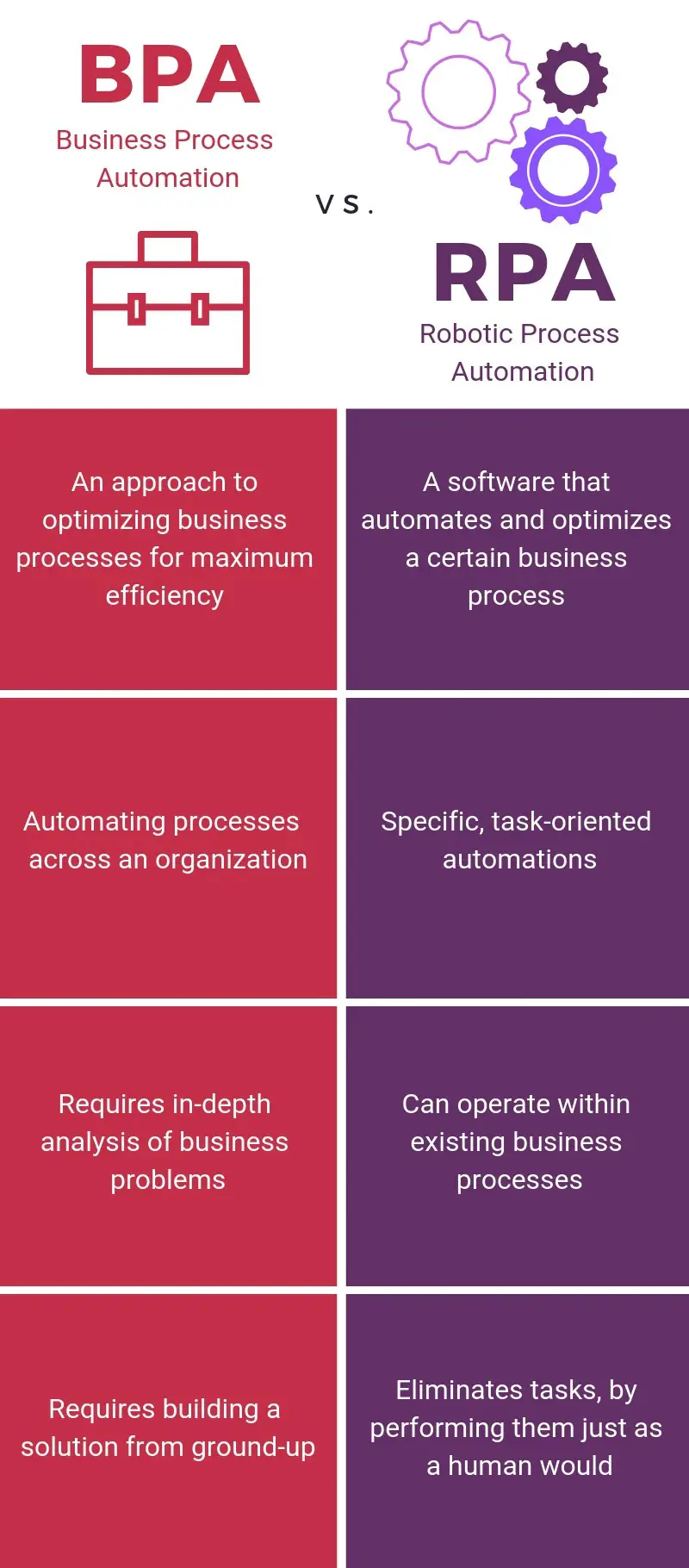
    business process automation vs robotic process automation

    What is business process automation?

    Business process automation (BPA) is an approach to optimizing entire business processes with automation. The goal is to eliminate repetitive workflows to improve efficiency and productivity.

    Business process automation doesn’t focus on one department or process, but rather looks at the organization on a holistic level to see which processes could be improved through automation. BPA covers end-to-end automation of a certain process or workflow.

    With business process automation, typically an in-depth analysis of the business’s inefficiencies is required to assess the largest problems the organization is facing. It usually also involves building a solution from the ground up, rather than adjusting and optimizing existing processes.

    What is robotic process automation?

    Then there’s robotic process automation, which is software that enables business process automation. Rather than attempting to automate an entire workflow, its task-oriented automations eliminate an existing process or co-exist within current processes to perform them more efficiently.

    A key differentiator of RPA is that the technology automates and completes tasks. However, RPA is not a machine or robot — it’s a software or application that replicates employee behavior by interacting with a user/web interface the same way a human would.

    RPA can be applied to various computer tasks to accelerate the speed and efficiency they are performed. Some use cases include: website scraping, payroll processing, document generation, underwriting loans, claims processing, membership renewals, order processing, and shipping notifications.

    The market for RPA is quite promising. Gartner recently calculated global RPA revenue on this technology to hit nearly $2 billion in 2021, with expectations that the market will continue to grow at double-digit rates through 2024.

    By 2025, the economic impact of implementing RPA into organizations is expected to reach $55 billion, with 35 million employees interacting with the technology regularly.

    BPA vs RPA

    Recently, robotic process automation has stepped into the spotlight. This is likely due to the simplicity of implementing and adopting it compared to BPA, which requires much more legwork.

    While RPA has become the more popular of the two, this doesn’t mean BPA isn’t important. In fact, when looking at BPA vs RPA, many will find they are just two different approaches to reaching the same goal.

    They both aim to drive efficiency and productivity throughout an organization by automating processes, and often these two types of automations can work in tandem. The key is knowing the difference and identifying which technology (or combinations of technologies) is best for your organization.

    If your business has major automation needs and requires a deep analytical assessment, then BPA may be the best bet. If you’re looking to optimize existing processes or just continue operations until you can do a major automation fix, use RPA.

  • Sales AI is here: terms you need to know | Automation Hero

    start new section

    Nearly half (46 percent) of company executives are looking to invest in artificially intelligent tools for their sales and marketing teams. Sales AI is going to change the way people sell and make sales team more efficient, productive and ultimately, drive some serious revenue growth.

    Sales leaders are eager to learn more and start implementing. Gartner predicts that by 2020, 30 percent of all B2B companies will employ sales AI to augment at least one of their primary processes.

    What this means for you (the savvy sales leader you are) is making sure you’re ahead instead of behind the curve and really understand the terms being thrown around. Sales AI is still very new, but hundreds of tools are already flooding the market. And with each tool comes new technical buzzwords, often leaving sales leaders dazed and confused.

    We’ve searched through the best case studies, ebooks and guides to bring you the most crucial need-to-know terminology to get you started on your sales AI implementation journey.

    1. Artificial intelligence (AI): Machines that learn from data and can perform tasks that normally require human intelligence. These include tasks like visual perception, speech recognition, decision-making and language translations.

    2. Sales AI: A tool that utilized artificial intelligence to improve the sales process. This can be in the form of automation in which a simple sales task is completed autonomously or through augmentation which assists in making predictions.

    3. Augmented intelligence: Tools and technology designed to elevate human workers and aid them in working smarter. This is seen as a compliment to humans rather than a replacement. Often referred to as intelligence augmentation (IA).

    4. Automation: Having a machine or tool that can perform a function with minimal human involvement.

    5. Sales automation: Using technology to automate sales processes through static roles. For example, converting leads into the next stage in the CRM based on triggers that occur elsewhere like sending out certain documents through email.

    6. Business Process Automation (BPA): Automation of business processes and workflows as a whole rather than one step or process with the goal of making the organization as efficient and productive as possible.

    7. Robotic process automation (RPA): Software that automates tasks and processes usually done by humans. This can be tasks like processing, manipulating data, and triggering responses. Essentially this is software automating the existing tools in your tech stack.

    8. Autonomous business processes: When a series of business tasks can all be fully automated with little human interaction or interference.

    9. Algorithm: In math and computer sciences an algorithm is the process or equation that a machine goes through to solve a problem, complete a task or perform a certain computation.

    10. Machine learning: A sector of AI when a machine uses a specific algorithm to solve a certain problem or do a certain task. These tools learn by finding patterns in data sets that they can then use to create an outcome. This is also called data mining.

    11. Neural network: Networks in an ML algorithm that simulate how the human brain works, where a network of firing neurons is connected to make decisions based on the input.

    12. Deep learning: A sector of machine learning that stacks neural networks on top of each other to achieve much higher accuracy than any other ML algorithm has before.

    13. Chatbot: A software designed to replicate human conversations.

    14. Knowledge-based AI: Humans assemble a handcrafted set of rules that are used to make decision graphs. These graphs often take a very long time to manual create by subject matter experts.

    15. Unsupervised learning: Machine learning models that are trained without receiving the correct “answer” to the problem their solving, meaning they learn through a process of trial and error.

    16. Supervised learning: Machine learning models that learn by comparing its own output to the “correct” output. If the system is incorrect it adjusts the algorithm accordingly.

    17. Reinforcement learning: Systems that learn based on a reward. They create outcomes are then are rewarded or punished based on those. It is only told whether the outcome is correct or not. Once the correct output is achieved, it will optimize for maximum reward.

    18. Natural language processing (NLP): The ability for a computer to understand, interpret and manipulate human language. This is also called text mining.

    19. Predictive analytics: When a machine can make predictions about the future using current and historical data.

    20. Intent detection: When a system uses NLP to predict the intention of a human message. This can be used to assist in getting the message to the right department or helping respond to the message.

    21. Crowdsourcing: A mechanism to motivate people to do something, in the context of AI it’s used to create data sets that are then used to train AI.

    22. Information extraction: When a machine mines for interesting pieces of data found in natural language text (for instance names, companies, telephone numbers, etc.).

    By Jessica Munday

    Content Marketing Specialist at Automation Hero, writing about technology, sales, AI and the future of business!

    Published May 08, 2019

    Posted in Innovation

  • 5 sales stereotypes that couldn’t be more wrong | Automation Hero

    start new section

    Sales isn’t for everyone. It takes a certain kind of personality and grit to be in such a challenging profession.  Sadly, not many in the outside world realize this. There are often misconceptions and sales stereotypes about what sales reps do and what type of people they are.

    Most people have no idea the amount of effort, thought, persistence and struggle salespeople go through on a daily basis.

    We’ll break down five of the most common sales stereotypes that salespeople hear from people outside of the industry.

    1. “They like to hear themselves talk.”

    People think that sales reps talk more than they listen, often hinting at the sales stereotype that sales reps are “pushy.”

    However, the best sales reps do more listening than talking.

    Sales is all about understanding a prospect’s pain point and sharing how a product or service can help alleviate it –  not just talking the sake of it. In fact, the ideal talk-to-listen ratio for a sales conversation is actually 57 percent for the customer and only 43 percent for the rep.

    2. “They are ego driven.”

    People outside of the sales industry assume because salespeople are typically social, and extroverted they all have big egos, which is why this is a common stereotype. This assumes that all salespeople are successful and exceed their goals, thus appearing to be overconfident and ego-hungry.

    But really, ego is one of the last motivators for sales reps. The biggest drivers for salespeople, according to Salesforce is 40 percent money, 30 percent job satisfaction, and only 12 percent recognition.

    Sales reps obviously enjoy hitting and meeting their goals, but so does everyone (it’s practically human nature). But just because sales reps value a job well done, doesn’t mean they’re looking for recognition to feed their ego

    3. “They are only concerned about making money.”

    Many sales roles include commission as a large part of the overall salary so this is an understandable sales stereotype as income essentially depends on performance.

    During this year’s Revenue Summit (hosted by Sales Hacker)Jacco VanderKooij, the founder of Winning By Design, and Rob Jeppsen, the CEO & founder of Xvoyant gave a keynote called “The 2020 Sales Leader.” They shared that while yes, money is the biggest motivator for sales reps,continuing education, experience and building a network are also high priorities

    4. “They are just out there winging it.”

    Only terrible sales reps go into a customer conversation without a plan and process. In reality, a vast majority of successful reps are extremely data driven, follow strategic processes and are committed, lifelong learners.

    Sales reps and teams overall are always looking to improve. That’s why some of the largest online communities and events are comprised of sales professionals. Just look at sites like Sales Hacker and events like Dreamforce. These types of communities would not be so successful if sales reps were unconcerned with improving their tactics.

    Reps are always looking for best practices and tips wherever they can. Thirty percent of sales reps get their best advice from their colleagues while 15 percent practice self-improvement by asking for feedback

    5. “It’s easy work with good pay.”

    Depending on the industry, product, location and performance of a sales rep, they get compensated very well. But the reason they are compensated so highly is because their job is so challenging.

    According to a 2018 LinkedIn report, sales representative is the second hardest position to hire for. They come behind skilled trade workers and above engineers! They are one of the most sought-after recruits in part because their job is so difficult.

    Part of what makes it so challenging is that they work long hours:

    • 28% of Sales Directors/VPs are working more than 60 hours per week
    • Only 9% of Directors/VPs work 31-40 hours per week
    • Only 19% of Sales Reps work 31-40 hours per week
    • Only 21% of Sales Managers work 31-40 hours per week

    Nearly 70 percent of salespeople describe their lifestyle as challenging, and 54 percent say their life is stressful. And one in two salespeople have been told by friends and family that they work too much, while one in three salespeople say their job negatively impacts their personal life.

    That doesn’t sound like easy work to me.

    Tell us some of the sales stereotypes you hear from those outside of the industry by tweeting us @automationhero_.

    By Jessica Munday

    Content Marketing Specialist at Automation Hero, writing about technology, sales, AI and the future of business!

    Published May 08, 2019

    Posted in Tips and Tricks

  • Find use cases for sales AI in your organization | Automation Hero

    May 08, 2019 by Jessica Munday

    One of the biggest challenges sales leaders face is the productivity and performance of their sales teams. Both SDRs (sales development reps) and AEs (account executives) put many processes and tools in place to help streamline their workload, but what happens can be the exact opposite. It’s a productivity paradox.

    This is an even bigger concern when you consider the cost of operating a sales team. Some companies spend up to half their revenue on sales alone. Salesforce, for example, spends 53% of its more than $10 billion in revenue on its sales team.

    Inefficient processes take a toll on a company’s bottom line. Sales reps spend 63.4% of their time on non-revenue generating activities. The results are missed quotas, lost revenue and poor ROI for the whole company.

    Smart sales leaders are looking to artificial intelligence for ways to help to solve this. In fact, Forrester found that 46% of companies are looking to implement AI in their sales and marketing teams in the coming quarters.

    So what does sales AI have to offer? It can automate repetitive processes that waste sales reps’ time so they can focus on connecting with their customers and generating revenue. Intelligent automation can also augment sales reps’ actions to help them make smarter decisions.

    Sales AI is poised to change the industry in the coming years:

    • IDC predicts that between 2017 and 2021, AI-powered CRM activities will boost revenue by $1.1 trillion.
    • At Dreamforce, McKinsey shared that currently about 40% of sales tasks can be automated, but by 2020, 85% of sales tasks could be automated.
    • Gartner predicts that by 2020, 30% of B2B businesses will have AI augmenting at least one of their primary sales processes.

    With statistics like these, it’s no wonder that companies are expecting a lot from these new technologies and are eager to implement. But many are unsure where to start.

    It’s critical for sales organizations to identify the inefficient processes that are holding their teams back from success and costing them money. Once the major business problems are pinpointed, your team can implement sales AI to solve it.

    Holding a use case discovery workshop does just that. Our format assists your business in identifying the highest value and lowest effort use cases so you can learn where sales AI is most valuable for your team.

    What is a use case discovery workshop?

    A use case discovery workshop helps business leaders create impactful change by bringing stakeholders  together to collaborate on how to put real applications for sales AI into motion.

    Use cases are easily taken from an idea into reality as the members of your team identify the problems they face on a daily basis. Having them identify their problems allows you to find a solution that will impact them directly.

    How to host one

    What makes hosting one of these workshops so valuable is that it is a bottom-up approach to finding where AI can help the organization. The point is to give everyone a voice.

    Invite members from every level of your organization to bring their own challenges and insights and hold high-value, cross-departmental conversations.

    What often occurs in large group situations is that people in lower-level positions tend not to speak up and let management own the conversation. This workshop encourages small group discussions and individual participation across the board. Both the Bystander effect and conformity psychological phenomenon disappear and your organization gains the “wisdom of the crowd.”

    Bring your employees together to share their own inefficiencies and learn about what other team members are experiencing throughout the organization. Make sure that they understand the goals and expectations of this workshop, which is to find use cases that will directly apply to their role.

    During the workshop, it’s important that you ask your participants to assume there are no barriers to implementation so that you can find a full spectrum of potential use cases. The sky is the limits here — assume there are no financial or technological restraints. You’ll have time later to assess and prioritize once these ideas have been generated. You’ll be surprised at what you come up with that could have a significant impact.

    Why it’s important to find sales AI use cases

    Implementing AI is a top business priority across all industries. In one survey by MemSQL, 61% of respondents say that machine learning (ML) and AI are their company’s most significant data initiatives for the upcoming year.

    This workshop helps you find the easiest and most beneficial use cases for your team so you can get up running ASAP.

    The correlation between AI and performance is also apparent, as top-performing sales teams are 3.4 times more likely to already be using AI within their processes. Get the ball rolling now for your sales team by holding your own Use Case Discovery Workshop.